


I’m sure it won’t surprise you that research shows if you design an AI lover and engage with it on the regular, over time you will find relationships with far more noncompliant and disagreeable real people less appealing.
I’ve been thinking about that this week in the wake of the Nara Smith controversy, of all things.
In case you’re not spending your limited attention span on influencer culture the TLDR is Smith—one of the most high-profile so-called “tradwives”—went on the very popular Call Her Daddy podcast and acted all surprised and offended that people had ever tarred her with the tradwife moniker.
Much internet scoffing ensued. Smith has spent many years perfecting her ASMR soft-spoken housewife brand, making Froot Loops from scratch in a full face of makeup and cutesy apron in her perfect kitchen.
Now, you might be asking yourself, “OK, Rach, but what does TradWife™ have to do with freaking AI girlfriends?”
So glad you asked. They both speak explicitly to a growing fetishisation of care.
The illusion of effortless care
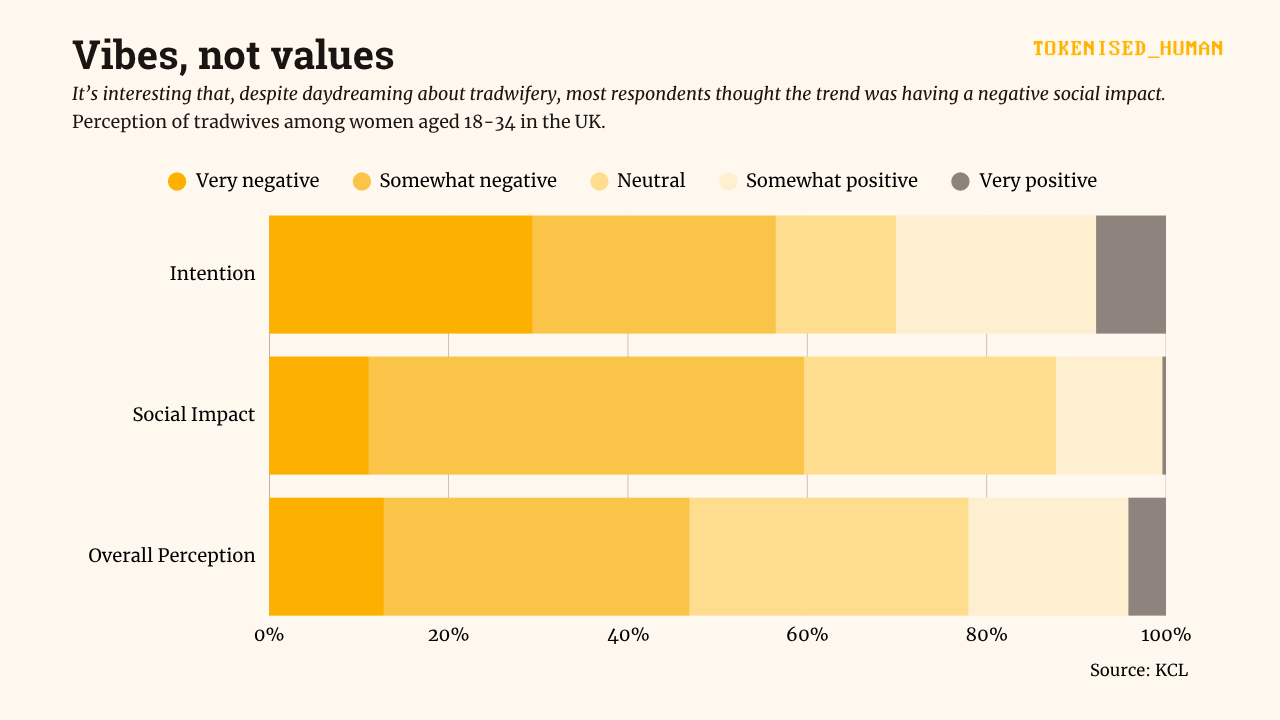
A 2025 report by researchers at the Global Institute for Women’s Leadership at King’s College London (KCL) found that lots of women—I’m talking 79 per cent in the test group—said they were attracted to the fantasy of “the calm, relaxed lifestyles” of trads; 62 per cent were captivated by their depictions of luxury.
It’s striking that a life devoted to endless service and chores is being consumed as “relaxation”—so long as that intense labour is done aesthetically, surrounded by the latest high-end appliances.
And the KCL study found the way young women felt about trad was nothing about getting retrograde or some conservative gender fantasy. Only 7 per cent of those same respondents thought blokes making all the decisions sounded hot. About a third liked the idea of a man being the main breadwinner and 44 per cent found “the idea of not worrying about a career appealing”.
That shifting attitude about work is a growing trend with dudes too. The research found 20 per cent of women and 21 per cent of men aged 18-34 perceived paid work as having a negative impact on their mental health—up from under 10 per cent who felt that way before 2020.
“Rather than a nostalgia around the role of women being limited to household labour,” the authors suggest, “the popularity of the tradwife phenomenon may be a symptom of the systemic strain experienced by the younger population, especially parents, who are juggling increasingly demanding jobs with intensive parenting responsibilities.”
It would seem the thing they’re really coveting is the appearance of abundance: abundant finances, skill, attention and, most importantly, time. Time is the greatest modern luxury.
And crucially, the appearance of choice in the matter.
But the trouble with selling women a fantasy of not working is that eventually they notice it is work—and that you’re at work while you sell it.
When tradwife is exposed as work
I spoke to Lauren Meisner this week, founder of the Gen Z media network Centennial World and host of the Infinite Scroll podcast.
She says young women are really waking up to the “grift” inherent in portrayals of the tradwife life. They know it’s not real and that women like Smith are literally working when they make this content.
“[Tradwives’] comments are flooded with criticism and mockery,” she observes. “I think a lot of young people have started hate-consuming trad content because they feel like leaving a comment telling a woman she is setting us back feels like a way to take out their anger and take back some control.”
Basically, it started out as a fantasy of peace, luxury and choice, but has become yet another high bar that women feel they are failing to reach on the daily. “I think a lot of women are like nevermind, let’s actually just go back to being sugar babies,” laughs Meisner (darkly).
The spotless floor problem
And this intensification of expectations is where the AI companion piece comes in, but also a broader allegory about how technology has, historically, raised expectations in all aspects of life. Rarely is new tech used to provide genuine relief from labour.
In 1983 historian Ruth Schwartz Cowan published a seminal study on the impact of new technology on household labour called More Work for Mother. (I looked for it everywhere and I couldn’t find a publicly accessible version, so I will instead link this related article Cowan wrote for American Heritage magazine in ‘87. It gives you the broad strokes, but if you like a narrative history I highly recommend you hunt down a copy of the book—it’s a fun read.)
Cowan’s research argues the introduction of whitegoods like vacuum cleaners and microwave ovens, which were marketed at the time as providing relief from chores, in fact just led to a new higher standard of expected domestic perfection. This is classic lifestyle creep—a ratcheting expectation as to what constitutes a “good life”.
I bought a robot vacuum a few years ago. I’ve become addicted. I now find it intolerable that my floors are ever anything but perfectly spotless.
And it’s not confined to the domestic sphere by any means. We’ve been in a perpetual state of work intensification for a really long time. Do you think industrialisation reduced the intensity of labour? Lol. Of course not. (See evidence here.)
One 2021 analysis published in the journal Industrial and Labor Relations Review said the particular squeeze over the first two decades of the 21st century has been thanks to some combo of reduced worker power, the constant need to learn and keep up with new technology, and bosses using that technology to organise, monitor and squeeze more work into every day.
Lifestyle creep of the mind
The same thing is happening right now with AI.
In a report published by the consultancy firm BCG in June, more than two-thirds of workers said AI had taken over simpler tasks, leaving them with the more complex work. Your boss will crow about this and call it a great thing—outsource the boring busy work to the droids!—but it also means more of your day is being dedicated to the hardest tasks with no easy filler tasks as relief.
Add to that: at least half the respondents also said they were spending more time reviewing and correcting AI output or managing and directing AI; 41 per cent said AI had increased the time they spent making decisions.
In the AI era I’d argue we’re entering a phase of lifestyle creep of the mind.
That is, a change in the kinds of work we choose to do—or are encouraged or even permitted to do inside organisations that are incentivised by speed and volume rather than the pleasantness of a worker’s day or the health of his individual intellect.
A lot of us are pretty worried about the potential erosion of our critical thinking and judgement if we become too dependent on AI.
When human contact becomes a luxury
It is also true of romantic and social relationships that can be in some fashion now supplemented or replaced whole cloth by an AI companion who never gets in a mood or disagrees or says no.
Which brings me back to where I started.
A team out of Oxford and Stanford published a preprint this year on a bunch of studies they ran getting thousands of participants to use an AI for emotional support.
They found, after three weeks hooked up to an intentionally agreeable AI, people were about as likely to rely on it as they were on their closest friends and family. Given a choice they picked the more sycophantic version of the bot too because they just liked the way it made them feel. Participants also reported being less satisfied with the real conversations in their lives.
That’s … not great.
It’s such a big potential problem that the Chinese government introduced a bunch of new rules regulating the availability and use of AI companions in July. Work AI assistants were specifically exempt. Read that how you like, but it looks to me like a government that’s fine with work intensification and not fine with us outsourcing our emotional needs. That’s a design choice.
So will AI give us back enough time and capacity to properly resource the parts of our lives that matter most? Or will so-called “efficiency gains” ratchet expectations to a new, higher standard of what a competent worker, good partner or functional human being is expected to be?
History suggests it will be the second.
I know I can’t go back to a dusty floor. We may not be able to go back to being listened to imperfectly by our fellow imperfect human loved ones either.
Maybe that is the real danger of abundance: once something becomes cheap and endlessly available, scarcity starts to feel like failure.
If this letter gave you something to think about, consider forwarding it to one person who’d enjoy it too! Word of mouth is how a newsletter this new finds its people.
And I’d love to hear from you — reply to this email, comment in the app, or find me on LinkedIn or Bluesky.
We traded the messy, high-stakes friction of actual human connection for a custom-built yes-man in a server rack. Rachel, this is an uncomfortable but necessary look in the mirror for us all, I think. And I enjoy your writing style too.
Again, a fantastic essay, Rachael! Though I'm not gonna lie, it's a bit dark and not a very joyful one. The solution I have for dusty floors is to be too busy aka lazy to replace the vacuum robot when it breaks. Does wonders in lowering your standards :)