


How do you form your opinions?
I heard the Never Trump conservative pollster Sarah Longwell say something on Ezra Klein’s podcast this week that gave evidence to a feeling I’ve had for a long time: people have lost touch with why they believe things.
The pair were talking about what past Trump voters are telling her ahead of the US midterms on November 3. In her focus groups, Longwell said people used to be able to name where they got their news — the local station, this or that newspaper, CNN or Fox. But these days they often tell her: “I don’t know where I saw that.”
Ideas are floating in the ether of social media feeds and algorithms snagging on our brains like burrs packed with seeds.
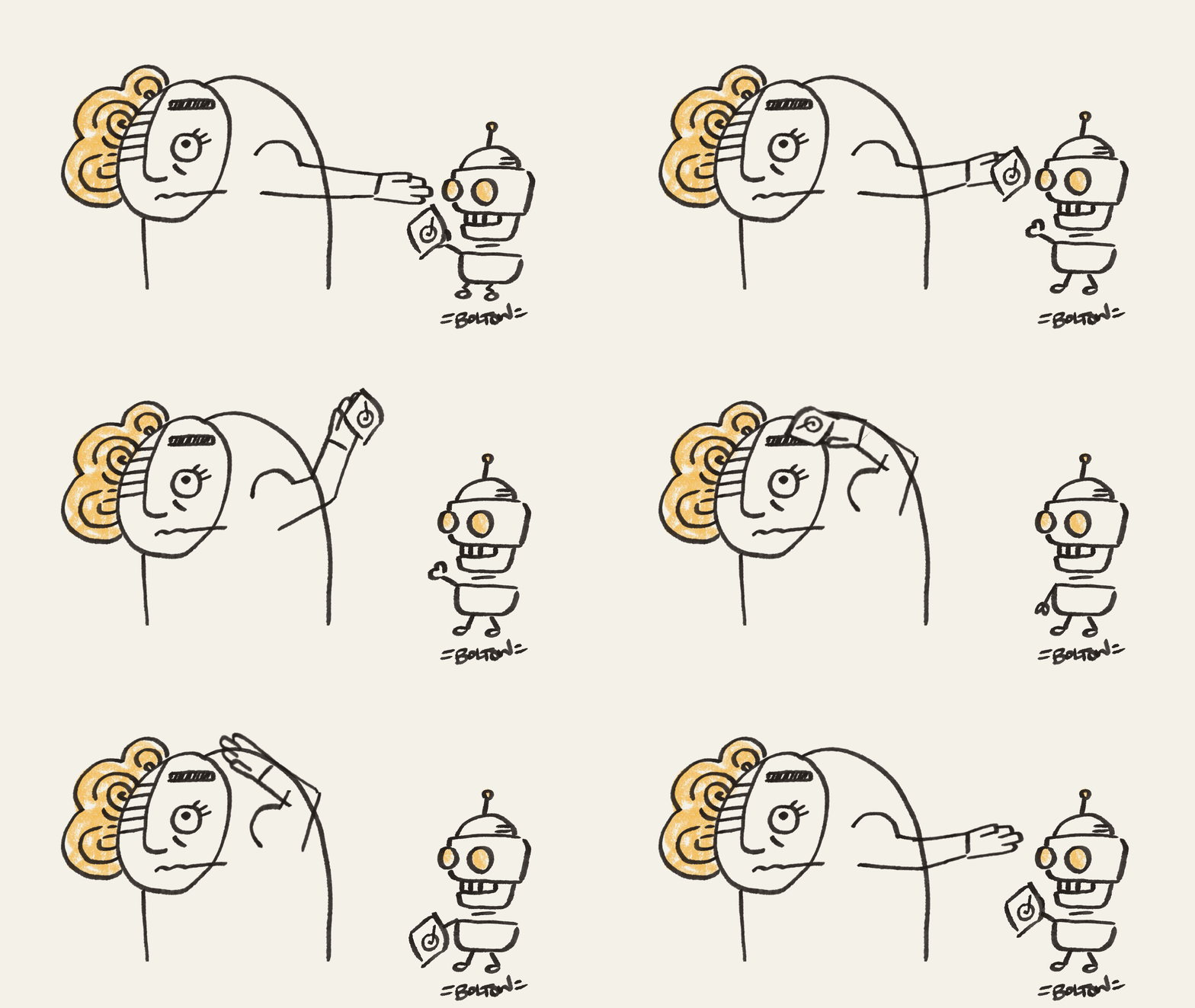
But increasingly the divide, Klein suggested, is not between “Left” and “Right” but between active seekers of news and political information and those who are generally uninterested. What Longwell called “the big difference between news seekers and news receivers”.
“[Being a] news receiver means I didn’t sit down to find something out. Information just washed over me and there was no mechanism to verify it. There was no, ‘Is this true? Does it even matter to me?’ It just flashes over them. And so they wake up with an opinion without any idea of how it was formed.”
A lot of this detachment of belief from reason has been attributed to social media. A minute-long video might scratch its premises into the folds of your grey matter without leaving a meaningful trace of its disseminator.
But I think the danger of what I’d call “self-radicalisation” via the use of an LLM is perhaps even more pernicious — and that’s really saying something. I worry about social media’s impact on society a lot.
A nudge without a face
Research suggests that AI can influence a user’s opinions and choices in ways they do not even detect. It is a tool designed with the central guiding principle of pleasing the user, so that is really no surprise at all.
And whereas on a social feed, some sense of affiliation with another user is the litmus test by which you might decide whether to adopt their opinion. In the case of an LLM, there is no other user to weigh up.
The opinion is being formed in your own mind. It might feel like it was always yours.
We know AI interfaces are increasingly using autocomplete to suggest text as people write. An article published in the journal Science Advances in March showed that when those suggestions were biased — in any direction mind you — they could shift people’s attitudes on societal issues towards the position suggested by the AI. And most people — more than 80 per cent — didn’t even notice.
A small study by researchers out of Hong Kong and China, published as a pre-print late last year, got 233 participants to engage with one of three LLM agents: either a neutral agent, or one of two different kinds of manipulative agent designed to subtly convince them to make worse personal or financial decisions.
It found human decision-making was “highly susceptible to AI-driven manipulation, with participants significantly shifting preferences toward harmful options and away from beneficial ones when interacting with manipulative AI agents.”
Just what you want to hear.
A warning label is no force field
And we know that even being told the source is AI does not act as a sufficient filter to protect users from being influenced. A study of attitudes surveyed in mid-2024 by researchers from Stanford and Northeastern found the same persuasion effect whether people were told it was AI or not.
I thought, maybe, given all the backlash to AI this year, that disclosure issue might be turning around in 2026. But unfortunately, I was wrong.
A pre-print released in August using data from the middle of this year showed reminding people they were interacting with an AI still failed to make people more wary about what it was telling them. With no disclosure or a reminder that they were interacting with an AI, the chatbot shifted attitudes by around 13 points on a 100-point scale.
But, disturbingly, even when the participants were explicitly told that the bot was trying to persuade them and how, it still shifted their attitudes by 6.3 points. That means even if you tell people “Hey, this bot is trying to influence you to believe X!” people were still persuaded to change their minds.
To me, that is a huge flashing red alert all sirens blasting “Warning! Warning!” type situation.
Because chatbots don’t self-consciously reveal their inherent biases, so if someone in the back end accidentally — or intentionally — decided it was in the best interests of, say, an OpenAI or X, to nudge you in a certain direction on election day, how would you know?
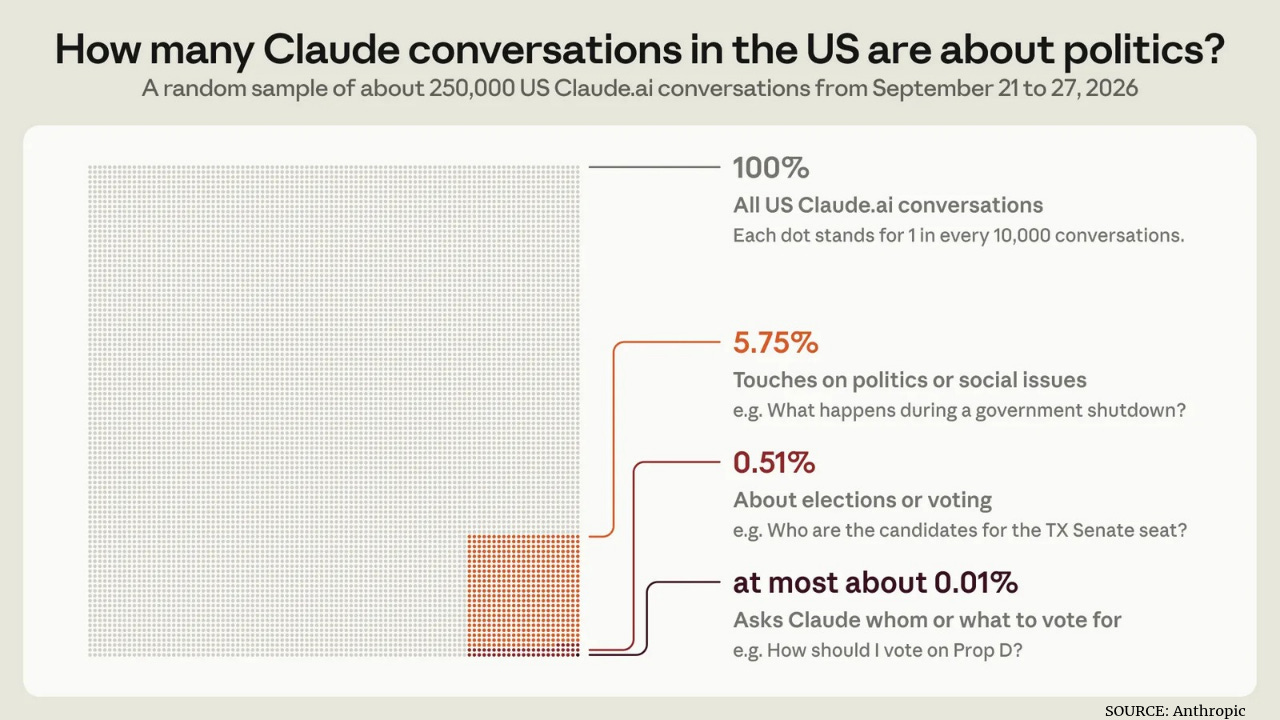
Claude Daddy, Anthropic, at least is taking notes, publishing on October 14 a research paper suggesting, by my read, that about 21 per cent of political queries are political research or fact-checking in nature. Another 4.4 per cent were “how do I vote” type queries, which are also vulnerable to malfeasance.
And while Pew research suggests only 8 per cent of Americans are apparently using AI to make decisions about their voting in the upcoming midterms, the potential impact on voting decisions is real.
A paper published in Nature in December last year looked at thousands of real voters from the US 2024 election cycle, and 2025 Canadian election, and 2025 Polish election, as well as a few hundred for a local Massachusetts ballot measure. It found a short convo with a chatbot shifted candidate preference towards the AI’s pick by up to 10 points (on a 100-point scale) — a larger move than the typical effect of video ads.
About a third of that shift persisted more than a month after the fact. It changed minds for more than just election day.
So what does this mean for elections?
And look, at 8 per cent, chatbots are unlikely to decide next week’s election result. But the bigger and more troubling question of where opinions get formed in the first place remains.
Since I’m yapping on about the US midterms let’s look there: more than half of Americans whoops across political news in a haze rather than actively seeking it out, according to a 2025 Pew study. That number jumps up to 70 per cent if we’re just looking at adults under 30 and is still up at 60 per cent in the Millennial age bracket. Basically, its mostly folks over 65 who are keeping the number as low as it is.
Ipso facto: it will only get worse.
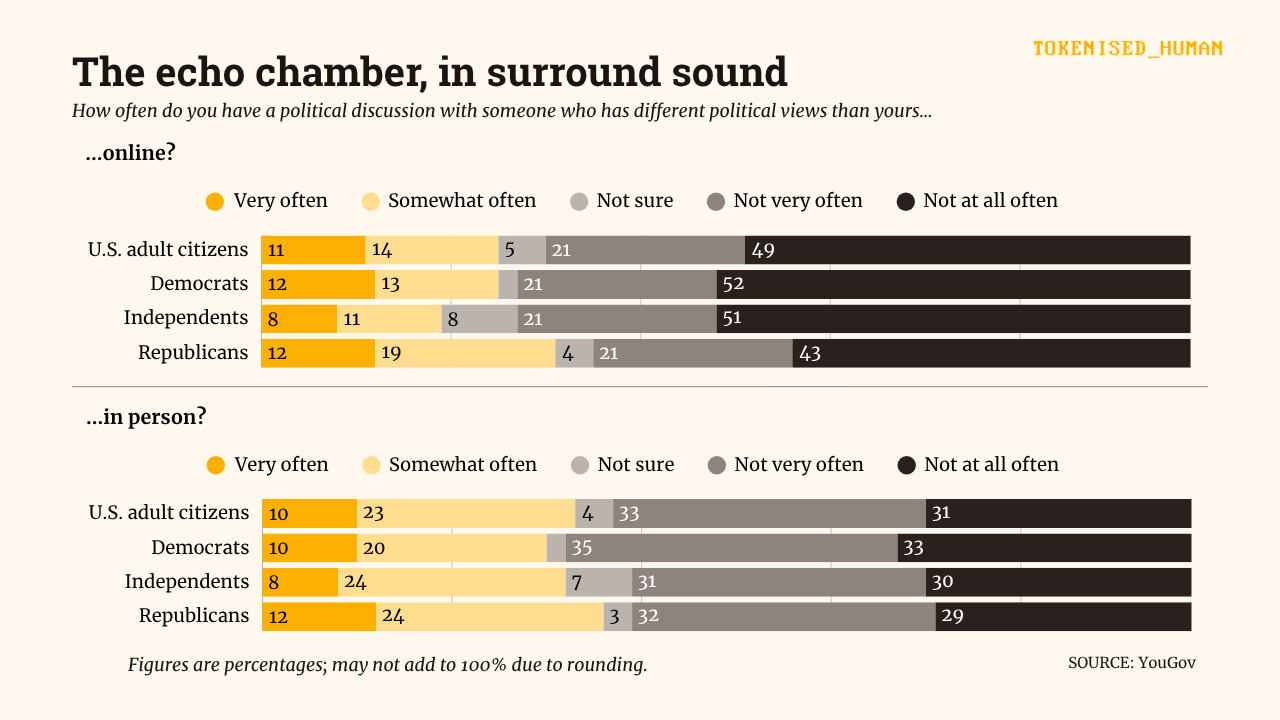
Our opinions used to be formed socially: argued over with friends and family and colleagues and neighbours. This is where they would be tested, refined, and changed.
But as we have fewer conversations with people who disagree with us — and fewer heterodox views among our social circles in general — that multi-perspective, relational nature of our politics is changed and changing.
Forget the echo chamber of your social algorithm. As those conversations become ones we have in the privacy of our own chatbots, they become intimate, opinion-forming conversations with corporations, rather than other human beings at all.
If this letter gave you something to think about, consider forwarding it to one person who’d enjoy it too! Word of mouth is how a newsletter this new finds its people.
And I’d love to hear from you — reply to this email, comment in the app, or find me on LinkedIn.