


Are you ever overwhelmed by a kind of existential dread and fear of your own insignificance in the grand arc of human history? Wow, that’s very dramatic of you. Are you ok?
I’m kidding, of course – I have definitely experienced this over the course of my 42 years on this planet. We’re so small and our lifespans feel so short. Leaving something valuable behind feels … like a kind of guaranteed afterlife.
Feeling valued, like we are doing or producing something important, is a super important part of being a happy human being.
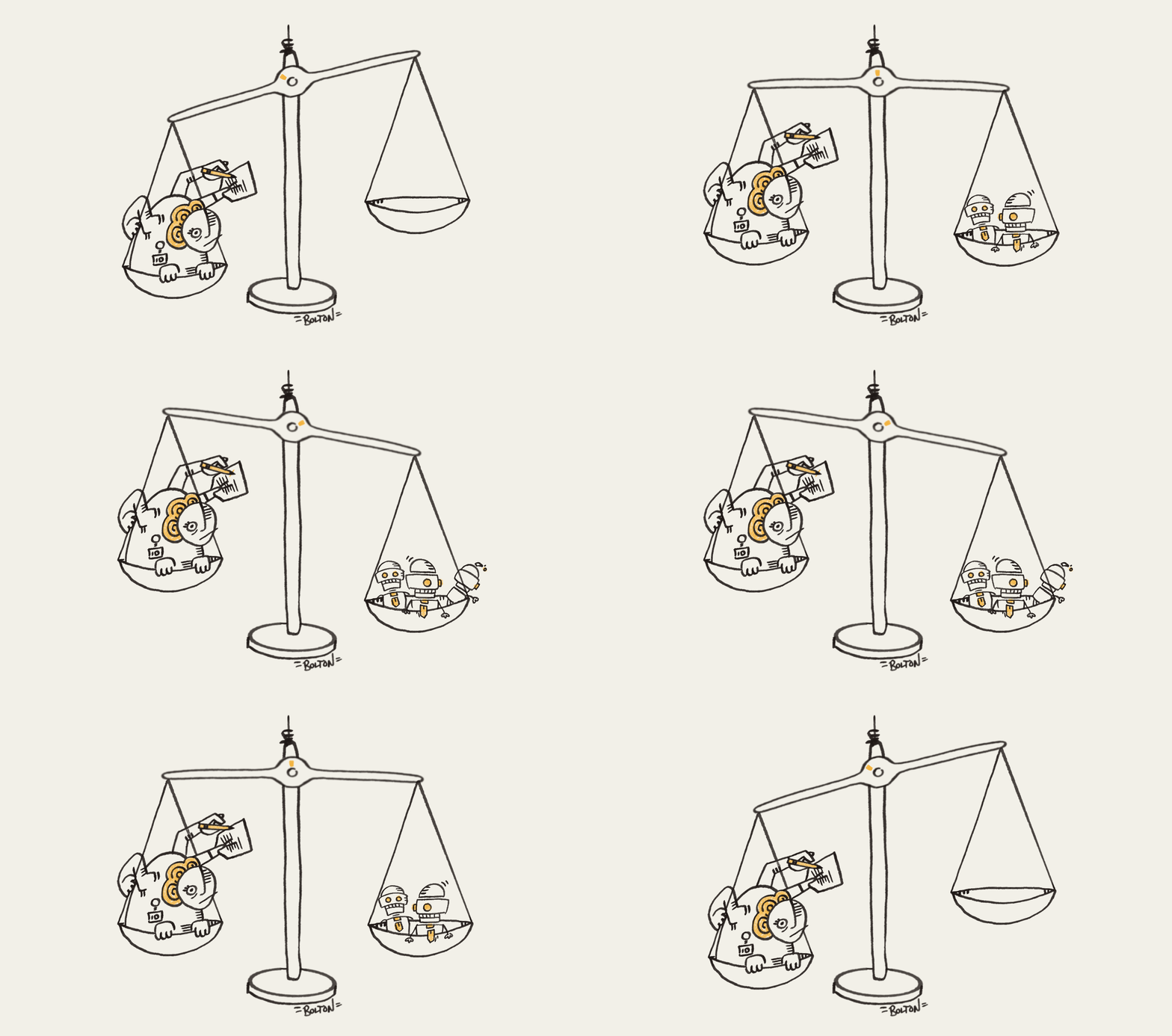
Academics call this the theory of mattering — what psychologist Isaac Prilleltensky describes in his 2019 paper for the American Journal of Community Psychology as “an ideal state of affairs consisting of two complementary psychological experiences: feeling valued and adding value.”
To feel that we matter, he explains, we need to strike a balance between the feeling of an internal sense of our own value, a sense of value in our interpersonal relationships and a sense that we add value to our broader communities.
But the philosophy of neoliberalism, Prilleltensky argues, is set up to place all the emphasis on a sense of personal value at the expense of community and even interpersonal relationships.
Our sense of value is pretty central to the way we feel about ourselves and our work. And to the ways AI is changing both.
The Department of Employment and Workplace Relations recently claimed AI isn’t denting the labour market, painting a picture of resilient jobs and zero “upheaval”. That would be reassuring, provided the things they measured were the things that mattered most.
The late David Graeber’s 2018 book Bullshit Jobs proposed that many people feel like their work is meaningless and contributes no tangible real-world value (fun fact: I used to illustrate some of his public essays!). In fact, he argued, many jobs – telemarketing, for example – are a net negative to both the people doing it and society at large. So binning those jobs, he would suggest, is a good thing.
But only if we adequately support those redundant workers on the back end with something like a universal basic income (David loved UBI).
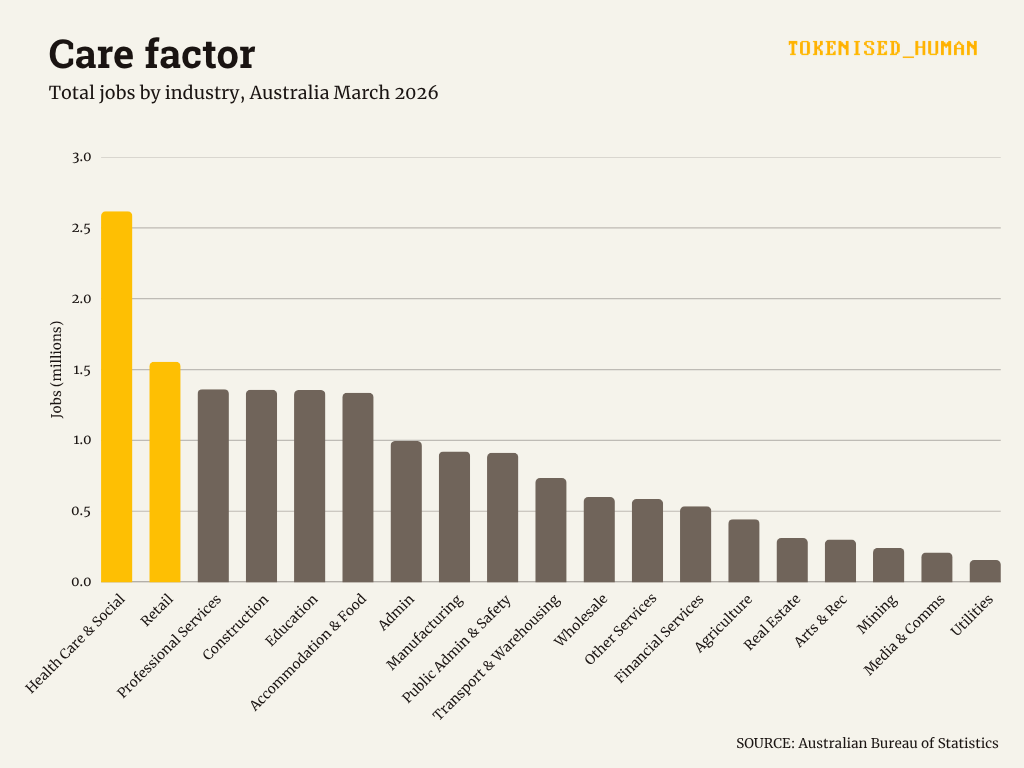
Repeated polling by YouGov has found at least a third of people in the UK feel their work made no meaningful contribution to the world.
The healthcare sector is the largest employer in the UK – and also a place where most people report feeling like their jobs matter. No surprises there. It’s followed by the retail sector, where most people report feeling like their contributions don’t matter. That’s a similar employment spread to Australia.
That’s how we feel about work. But how are we, as human workers, valued by the organisations that employ us? This is the part that really determines how secure we feel in our current jobs or in the idea that we will have one into the future.
A 2026 report by research firm ADP found only 22 per cent of workers globally are confident their roles are safe from “elimination”; job-security anxiety was worst among lower-paid workers doing repetitive tasks.
That anxiety isn’t just an individual stressor, it’s hardwired into the cold mathematical engines of corporate productivity.
Anyone who has followed my work over the last year or so will know I have a bit of a preoccupation with the math of productivity measurement. One of the most common measures is essentially this:

Whenever you have heard people crowing about stagnant labour productivity in Australia in recent years this is the number people are mainly freaking out about. It’s been stuck at around $100 for about a decade. According to the Productivity Commission’s latest stats labour productivity was down 0.6 per cent in the March quarter.
Economists really hate that. But why?
It’s a totally reasonable question and the answer is … kind of stupid. It’s about debt. The entire economy is built to keep that number climbing, because continuous growth quietly shrinks old debt.
Basically, banks keep issuing private debt (mortgages, business and personal loans etc – we call that private credit expansion) and governments keep accruing national debt to fund all their programs, and to pay off past debt (it’s a bit of a vicious cycle, like borrowing on one credit card to pay off another).
This means that if companies and the government can’t make more money per hour worked — basically forever — then wages will keep drifting upwards anyway and that puts a squeeze on profits, which means prices go up. That’s inflation, baby.
But if AI successfully automates any significant portion of those human hours, the wages needed to service that mountain of debt disappear. The entire financial system relies on our continued, measurable labour just to keep it from collapsing. If the jobs vanish, the debt trap springs shut. I guess the banks will eventually have to start issuing mortgages and high-interest credit cards directly to the algorithms?
So everyone is incentivised to push the relative value of those dollars down by growing the pie. Your $500k mortgage will become easier to pay down if your $100k salary grows to $150k, everything else also gets more expensive, and the buying power of that $500k, which you borrowed years ago, also goes down in today’s money. (It’s also one of the many factors that make housing so unaffordable these days, but that’s a separate issue.)
My parents bought a two-bed Victorian cottage in Melbourne in the 80s for $33k. To them, at the time, that was a lot of money. By comparison, these days, a $33k mortgage is incomprehensibly small.
But increasing the output of every hour of human labour is only a good measure of productivity when the things those humans are producing are measurable in quantity.
For example, if I am a doctor and I see, on average, 10 patients a day, doubling that to 20 patients in the same number of hours means overall quality of that care goes down. When quality and service are your measures, increased quantity does not equal improved output.
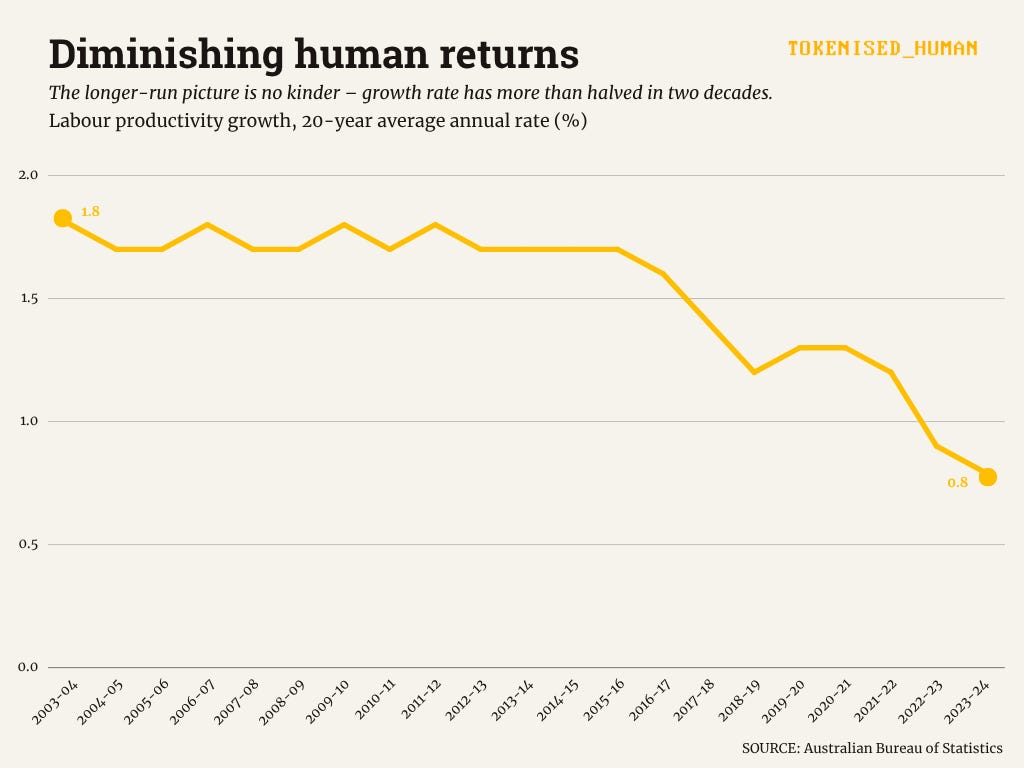
And even on the pure economics front, it’s not supposed to be this way.
The economist who invented the concept of gross domestic product in the 1930s, Simon Kuznets, believed the growth phase was a sign of economic immaturity. Once the citizens of a country enjoyed a generally high quality of life, flatlining was the goal.
As he wrote in a 1934 report to the US Senate: “The welfare of a nation can … scarcely be inferred from a measurement of national income”.
In other words, don’t use GDP alone to decide if you’re doing a good job taking care of your citizens! Just because a country as a whole is technically making more money, that doesn’t mean the individual people are better off, and lower labour productivity is not the same as an economy in a bad shape.
I reckon Kuznets would be pretty annoyed at how things are going right now.
And it raises a really important question as we face a future where companies at least believe that AI will be able to drive better labour productivity. Sure, the math might get better at the GDP level, but if that is tethered to a reduction in the human workforce, a better GDP figure absolutely does not equal better conditions or outcomes at the individual level. When DEWR celebrates a “resilient labour market” amidst the rise of AI, they are relying on this exact aggregate-looks-fine illusion.
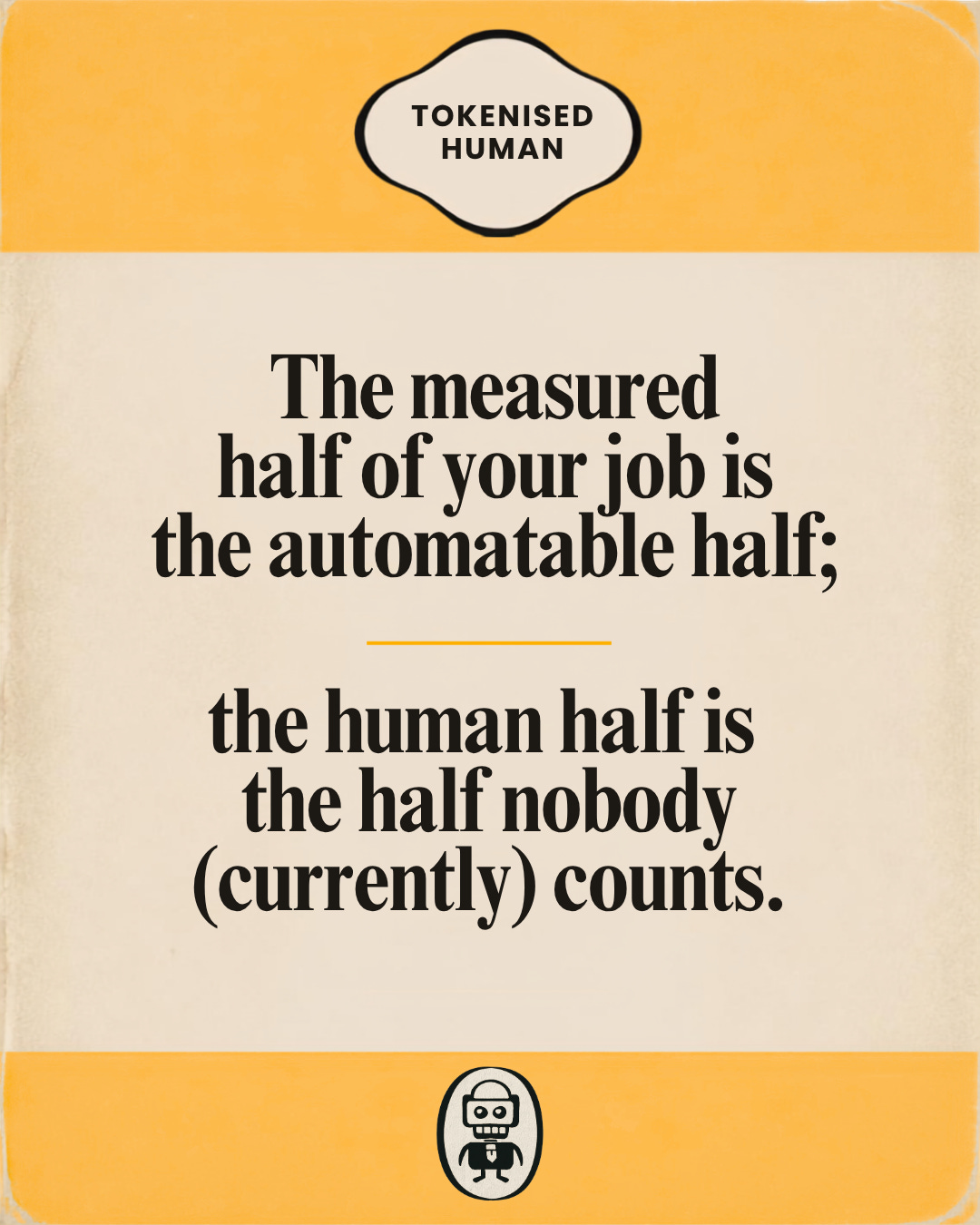
What I am trying to get at here is that the tasks companies have traditionally measured as “valuable” are often the repeatable, easily quantifiable ones – the ones most vulnerable to automation right now. One very real version of “improved productivity” is “do the same (or more) with far fewer human hours of labour to divide by”.
And while your boss might talk a big game about valuing the “human skills” like “critical thinking” or “stakeholder communication”, those are often the least measured and most subjective parts of a job. If a company can’t draw a straight line between a task and its profit margin, that’s not a task set up to survive this moment in labour history.
The measured half of your job is the automatable half; the human half is the half nobody (currently) counts.
Professor Nicholas Davis co-leads the Human Technology Institute at UTS and, when I spoke to him this week, he really put his finger on why. He pointed out value in economics means something precise: “thanks to demand and supply, what people are willing to pay for something.” It’s a measure of scarcity.
We’ve been pricing human labour with a scarcity metric and AI’s whole trick is to yoink the rug on what made it finite and scarce to begin with.
So the question becomes, how are we going to measure human contributions in a way that effectively captures their true value so that we can protect and preserve that value inside organisations? And given the nature of most organisational structures and imperatives, is that feasible or even desired?
The way we measure work is a deliberate design choice, not an inevitable law of nature. If our economic metrics only value the automatable, we are choosing to build a future that has no room for people.
If this letter gave you something to think about, consider forwarding it to one person who’d enjoy it too! Word of mouth is how a newsletter this new finds its people.
And I’d love to hear from you — reply to this email, comment in the app, or find me on LinkedIn or Bluesky.
I always appreciate a good refresher on these basic economics, because they're so ethically counterintuitive, even though they make perfect sense from a mathematical standpoint. Which is kind of the pinch we're in, isn't it?
And then there's what whole concept of "emotional labor." Somehow that's percolating in my mind as I read this...
Which is to say, I think you're spot on to be talking about what *matters* at this moment in time. Do you get the sense that maybe AI might force a huge reckoning in that area, even apart from the direct questions about AI itself?
I look forward to reading more of your work!
💯