


I speak to people all the time who are worried about whether robots are going to replace workers.
And, look, am I worried about that? I think by now you know the answer is obviously yes. Without a pretty clear idea of what a good post-work world would look like and how we’d get there I think getting loosey-goosey with baseline unemployment is a bad idea.
But I’ll be honest, I think the more immediate concern is the shape a lot of work right now is taking.
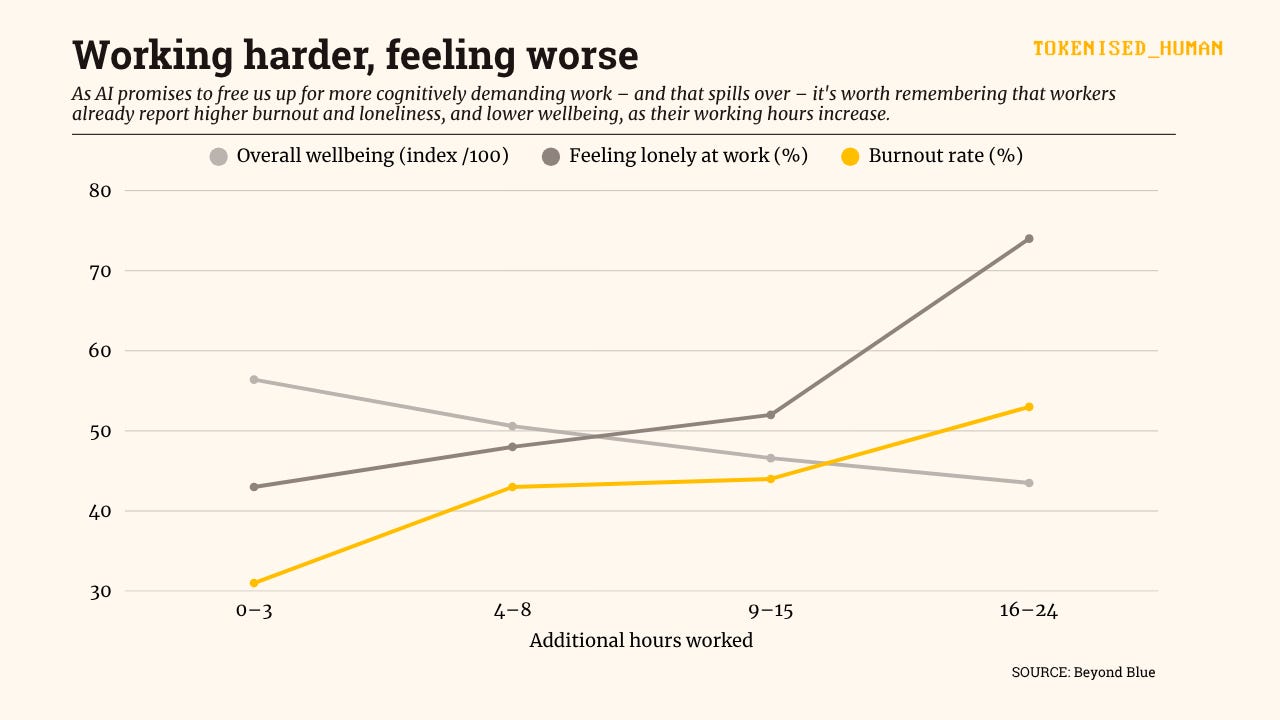
Work intensification is real.
And a report by Unions NSW published in September found 20 per cent of workers said employers expected higher outputs since introducing AI tools, even though the tech had “failed to reduce workloads for more than three-quarters of Australian workers, including one in eight whose unpaid overtime has increased since the technology was introduced”.
A 2026 survey by Safe Work Australia found more than 37 per cent of Australian workers reported experiencing tight deadlines or work pressure often or all the time. That lines up with an Ipsos poll finding from January last year that 40 per cent reported feeling under constant strain in the preceding six months.
Just last week Anthropic dropped a new paper showing how AI was intensifying work inside its own organisation. It claimed employees were producing more, but also taking on a larger number of tasks and more different kinds of task.
The company’s median employee now spends 20 per cent more time in meetings than a year ago, while one worker described the strategic component of their job expanding from 20 to 90 per cent. Meanwhile, AI agents are producing so much material that human attention has become a bottleneck.
This will, I suspect, surprise exactly no one.
But here’s the really messed up part: they’re doing all this very deliberate intensification, dressing it up as people “getting to do more of the bits they enjoy” and completely ignoring the fact that cognitive overload is basically the perfect driver for cognitive offloading.
If you have way more things to do, and a hundred different balls in the air, the incentive for you to click that little magic AI “approve” button and offload your revision and critique is enormous.
As I said in my final episode of season one of the podcast last week: one of the best ways to predict the future is to look at the incentives that we’re putting in place right now.
And by my reading, a lot of those incentives are pointing us towards outcomes we say we don’t actually want.
When I spoke to organisational psychologist Dr Tim Ballard recently we talked about something I think is being almost entirely overlooked in the rush to automate the boring parts of our jobs. (Side note: if you don’t follow him on LinkedIn yet you really should, he’s one of my favourite workplace data nerds.)
First, those boring bits might actually be providing our brains with necessary recovery time between more cognitively demanding tasks — as Ballard put it “to give our brain a little bit of a break”.
We’re assuming that removing them will make work easier, without considering what happens when the proportion of our day devoted to difficult thinking goes from — as that Anthropic worker claimed — 20 per cent to 90 per cent.
But there’s another problem too. We don’t really understand how much of our professional judgement is developed through the very tasks we’re now outsourcing.
Years spent reading, researching, checking, repeating processes and identifying patterns might be doing far more to develop our expertise than simply producing the work we’re being paid to deliver.
Take the example of junior lawyers who increasingly rely on AI to perform foundational research. Right now, experienced senior lawyers can review that work and identify mistakes. But what happens in 20 years, when those graduates become the senior lawyers responsible for making those judgements?
“There’s a real sustainability question,” Ballard said. “The word we use in organisational psychology is deskilling.”
And if we don’t fully understand exactly how expertise develops, how will we know what we’re losing when we automate the process?
Fancy a bonus round? Catch me on the very excellent Get EVEN podcast this week for a conversation about women, work and AI. You can listen on Spotify or watch on YouTube.
The EVEN team is also running a Women, Work & AI survey. If you’d like to participate you can do so here.
We already have a burnout problem in this country. This year’s State of Workplace Burnout, published on Monday, found 36 per cent of respondents were experiencing burnout, while 43 per cent of those workers reported that the quality of their work had declined, compared with just 11 per cent of workers who weren’t burnt out.
More than half of respondents said they were struggling to keep up with the pace and volume of the work expected of them, while 74 per cent said they ended a typical workday mentally and emotionally exhausted. None of that is great.
We actually know that people cannot sustain this kind of increased work intensity over long periods. Just ask the researchers who designed four day work week experiments over the past few years.
Earlier this year, I chaired a panel at the AFR Workforce Summit with University Technology Sydney researcher Dr Rowena Ditzell, who evaluated Unilever’s four-day-week trial in New Zealand. Workers were asked to deliver 100 per cent of their usual business outcomes in 80 per cent of the time, without taking a pay cut. And the company exceeded its sales, profit and market-share targets, while absenteeism fell.
But the crucial distinction is that those productivity gains were accompanied by extra time off. The point was to make work more efficient so people could work less, not simply extract more work from them. And the wider four-day-week research suggests that recovery time is an important part of what makes those gains sustainable.
A paper published in the Journal of the American Medical Informatics Association way back in 2016 found the risk of over-relying on automation increased when tasks were cognitively demanding. So we have known about this for a literal decade.
The boss can insist on keeping a human-in-the-damn-loop all he wants, but if he doesn’t give that human the time, space and mental conditions to check that AI slop properly it doesn’t make a bean of difference.
(While we’re brushing past this subject, let’s all make a pact that we will never say H-I-T-L out loud, ok? It’s not shorter to say and it makes you sound like a wanker.)
More recently, a 2025 study by Microsoft and Carnegie Mellon University found that the more confident people were in AI’s abilities, the less critical thinking they reported applying to AI-assisted tasks. Quelle suprise.
So to recap: we are actively increasing the amount of cognitively demanding work people are expected to perform, expanding their remits into areas that they are potentially less specialised in, giving them tools that make it incredibly easy to pass off some of that load and meet their KPIs, and then acting surprised when they do.
I’ve been known to say offloading onto AI is like cheating on your spouse. Do it once, get away with it, and it will be easier to do it again and again. It is a slippery damn slope.
Research released by Wharton this month found 44 per cent of surveyed managers identified improving productivity as AI’s primary expected role, compared with just 15 per cent who prioritised improving decision quality.
In other words, we’re measuring success by how much extra work the machines help us produce, while claiming our valuable human contribution is our ability to think critically about that work.
And what do I always say? The thing we measure is the thing we ascribe value.
If this letter gave you something to think about, consider forwarding it to one person who’d enjoy it too! Word of mouth is how a newsletter this new finds its people.
And I’d love to hear from you — reply to this email, comment in the app, or find me on LinkedIn.