


When I used to teach journalism and social media studies at the University of Sydney years ago, I developed a kind of thought experiment I liked to run with my students. It goes something like this:
Is Facebook remembering your friends’ and family’s birthdays, so you don’t have to, a problem?
How about if it automatically sent those friends a “Happy Birthday” message?
What if the reminder came with a link to gifts that person might like populated by that person’s search history, recent purchases and other cookies?
How about if it was linked to your credit card, had an agreed budget and just purchased its best guess at what they would like and had it sent to them with a generated birthday message?
At its core, this is an exercise in considering at what point outsourcing your relationships to a machine feels like a degradation of the relationship itself. And even though it’s been almost a decade since I started posing that question to my students, I’m not sure we have gotten any closer to a universally agreed answer – even as the proposition has become more and more aligned with reality.
A friend told me only this week about how a bunch of his colleagues were using the AI “suggestion” button to fill out a digital leaving card for a departing teammate.
(In my opinion you either default to something generic – “You will be missed!” / “Congratulations on the new role!” – or you think of the thing you most like about that person and make it about that – “Your Friday muffins will remain company legend!” or “I always appreciated how much care you brought to your work.” To me, outsourcing it to a bot feels worse than skipping the card altogether.)
And there were two other reasons I started thinking about it again this week.
First, I clocked this article on Business Insider on “the modern parenting throuple” – the idea of adding an AI “third” to your marriage and parenting decisions. (I’d argue a digital polycule is probably more accurate – what modern couple only has one AI between them?)
In that article, one parent said she had spent the previous year travelling for work, so she built a custom GPT of herself for her 15-year-old son to consult when she was unavailable. She programmed it with her personality, screenshots of their texts, her family values and rules, and the parenting challenges she was dealing with.
(Yes, I am aware I am being kinda judgemental and shady about that. I want to be clear I would also be just as shady if it was a dad doing it – this is not a gender issue.)
The second thing was this gadget gathering steam with techbros and normies alike called the Brick. It’s a physical tile and app combo that you use to limit your screen time. You tap your phone on it and it “bricks” you. It will stop you opening certain apps, etc – you decide the rules – so you can’t keep doomscrolling or whatever.
So we invented a gadget that replaces… turning off your phone? Putting it in another room? Deleting your social apps? Exercising self-control? Yes. Apparently that is what the Brick is for.
There's a hole in my life, dear Liza
Those two things may feel like different phenomena, but hear me out.
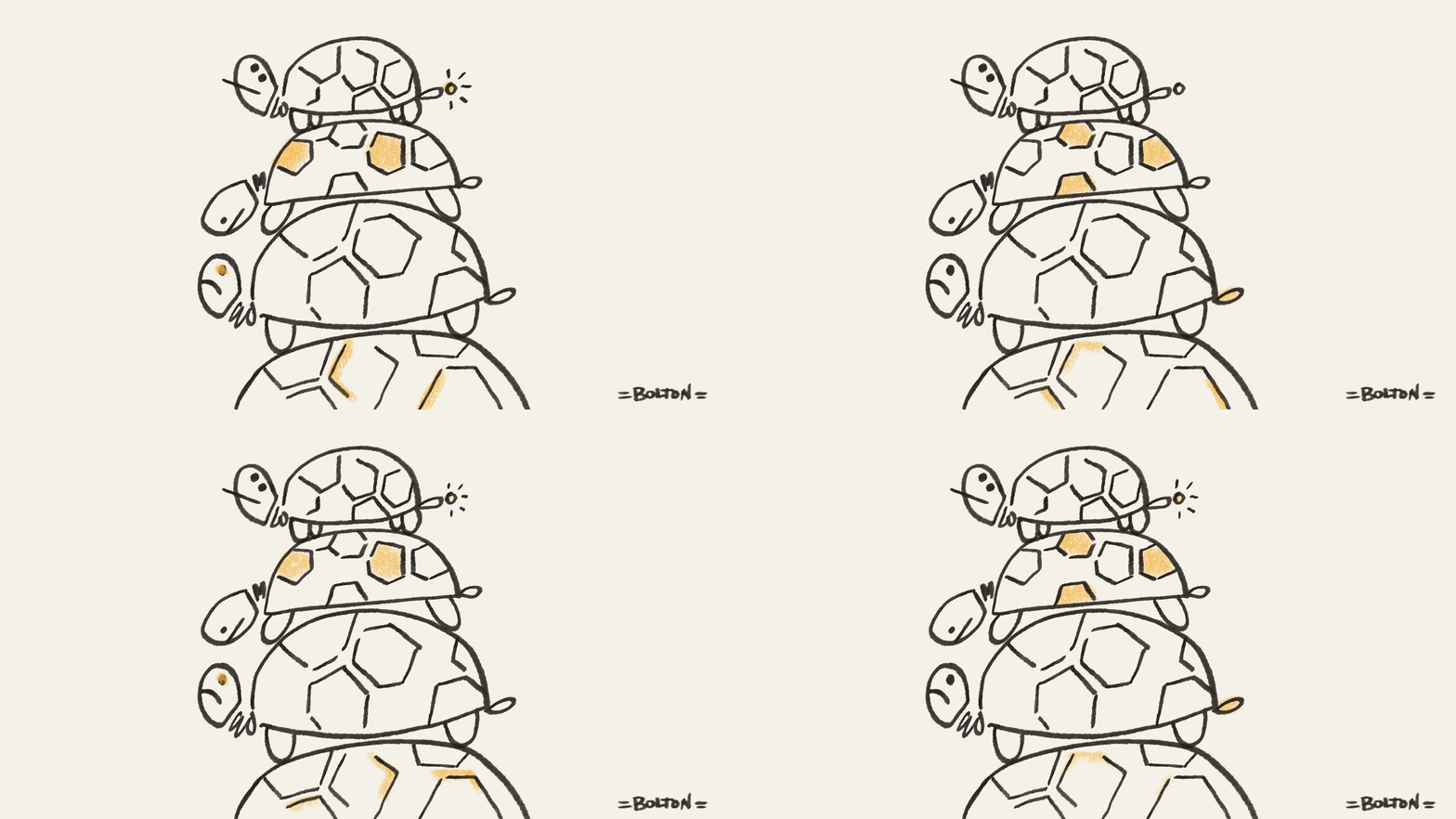
The through-line is something researchers call “techno-fixing”. That is, using a technology to patch a problem, rather than repairing or changing the underlying system.
The point is not that the technology caused every problem. It’s that it lets us preserve a broken or failing system that produced the problem instead of changing it.
And the ways we choose to techno-fix and patch the problems in our own lives tell on us a little – or a lot.
No hack for un-burning a match
Let’s say you’re in a permanent state of cognitive overload due to … I don’t know, the escalating cost-of-living pressure, general global uncertainty, and overwork. Perhaps you recently lived through a global pandemic and a bunch of lockdowns. Maybe you’re either in or edging on burnout. And that’s leading you to withdraw.
A Beyond Blue survey last year put the number of Australians facing workplace burnout at 49 per cent. And the one that always shocks me: a 2024 KPMG study found rates of permanent disability from mental health conditions in Australia, specifically among Millennials, are up 732 per cent since 2014. That’s an insane figure.
And OK, let’s assume you’re not quite at the total permanent disability threshold just yet. You’re just medium miserable. Great. When we’re burned out we have a tendency to lose interest in doing … stuff. Just stuff in general. So we veg out in front of the TV. We cancel on our friends. We doomscroll.
Rather than question the wisdom or sustainability of that system, let’s throw some bandaids on the problem.
At the same time, productivity-maxxing and career optimisation culture tells us we can do all the things if only we work hard enough, eat and sleep like a machine, and recruit the right combination of gig workers and fancy new tools.
Of course we could, instead, sit down at the dinner table of life and decide which course we would actually like to focus on digesting right now. We could pare back on some things so we have the bandwidth to properly focus on that area. And we could build supportive proximate communities composed of family and friends and people we know who help each other out. You know, community.
The truth is you can have many things in life, but not all things. You’ll probably have to work really bloody hard for the things you do have, a bunch of it will come down to dumb luck, and you most likely can’t have even those things at the same time. Life is full of seasons. Knowing which one you are in right now will save you a lot of grief.
But instead we, what? Develop another app? “It’s called AtaBOI and it’s, like, Uber for your dad’s approval,” says a completely deadpan 22-year-old Stanford dropout while he records you on his Meta glasses.
Robo-Mommy gives cold hugs
Let’s consider that AI parenting “augmentation” situation, for example. There is a difference between using a tool to help with the logistics of parenting and using it to stand in for the relationship.
Look, parenting is bloody hard. And frequently tedious or annoying or just not what you want to be doing at 10.30pm on a Tuesday. I have a teenager myself. I fully understand that thing where you think to yourself, “Phew! We made it! They are going to be more independent now, right?” Only to realise, no, teens need you almost as much as a toddler does.
And I know we want to support people to do the jobs they are passionate about and take all the professional opportunities they want to, but that is not always possible. Sometimes we have to make personal sacrifices for our families, or our health, or to housebreak a puppy, or because our best friend is going through a really difficult time right now.
It’s not a sexy, fun or particularly comfortable reality, but it’s the truth.
I was speaking to the Australian futurist Aaron McEwan on Wednesday about a new book he is writing on surviving the AI era with your humanity intact.
In researching that book he found evidence that attending live music was “substantially better for your well-being than just listening to it on a recording”. It’s because you’re in a community, but also because of “the effort of going to see it”. The effort matters. Choosing to spend your limited bandwidth on that activity is a declaration to the world and to yourself as to what you most value.
Ultimately, I think it comes down to your true internal compass and the lynchpins on which your specific ego is built.
If I outsource my parenting and use the AI as a proxy for interacting with my own kid, I do not get the benefit of that effort. Worst case: my child bonds to the AI, trusts the AI, turns to the AI instead of me. I am ultimately poorer for it.
I can’t send you to the gym and expect to get fitter myself.
The areas of our lives that we choose to patch do ultimately tell on us. The question is whether, in trying to preserve every single opportunity and solve every problem with a tool, we are accidentally deprioritising the things that are most important.
If this letter gave you something to think about, consider forwarding it to one person who’d enjoy it too! Word of mouth is how a newsletter this new finds its people.
And I’d love to hear from you — reply to this email, comment in the app, or find me on LinkedIn or Bluesky.
Brilliant
The patching is so hard to not sleepwalk into. It starts little and occasional and opportunistic, before you know it, it's everywhere and you're in too deep. But, also, I guess, that's how Big Tech wants it, so it's impossible to escape 😶🌫️