


What is the point of school?
Over the past year or so I have been contacted by a whole bunch of parents, career counsellors and teachers who wanted to know what they should be telling their kids about preparing for an AI-affected workforce. The question sounds simple: what should my kid do now?
They were writing because at the end of last year I wrote a series on whether a university degree was still a valuable investment for a kid preparing for the modern workforce and later this piece where University of Sydney Business School’s excellent Prof Clinton Free crunched the numbers on Anthropic’s most dire workforce predictions, which went kind of viral.
But despite all the research I have done, all the very smart people I have spoken to, I didn’t have a great easy answer for any of them.
Because, uncomfortably, I have come to believe the question is too small and assumes that the answer is a tweak, rather than an overhaul. I’d suggest the real question we need to be asking is: what is the point of school at all?
So you can see, I’ve been mulling this question for a long time, but it resurfaced this week as I scrolled through all the posts on social media responding to a new preprint published by researchers out of Stockholm University and the University of Hong Kong in June.
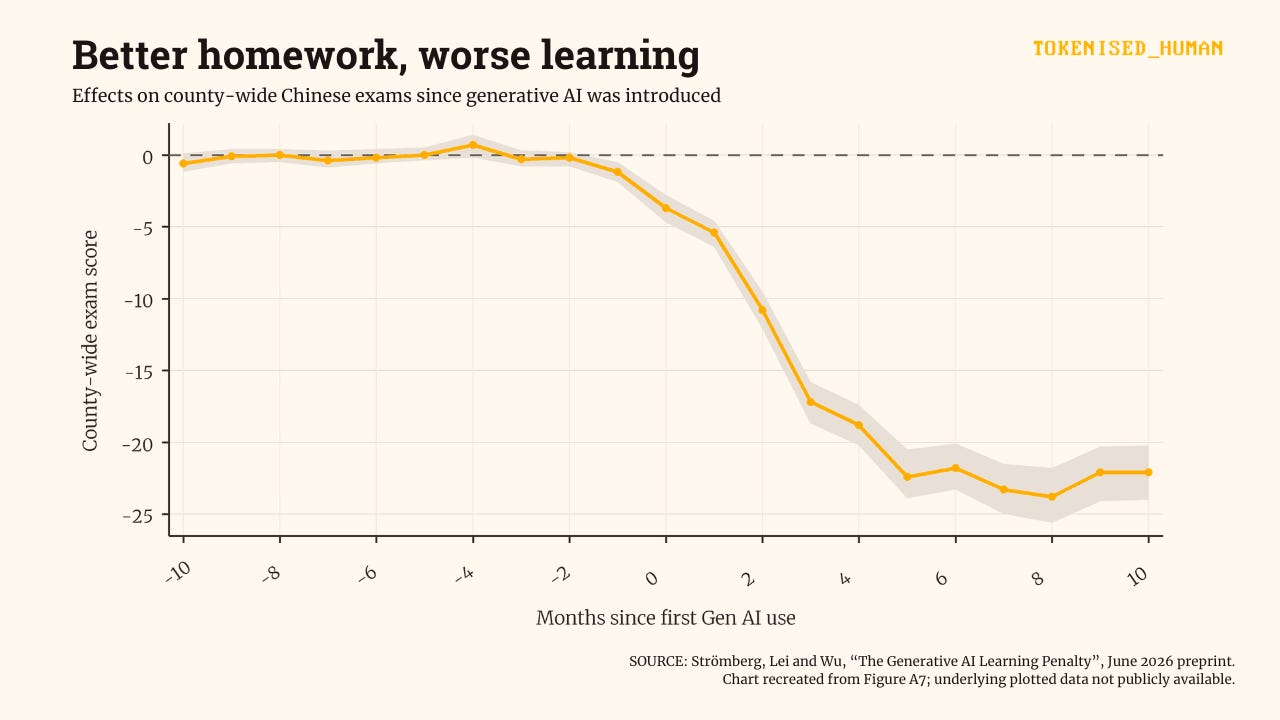
In case you missed it, the study looked at the learning outcomes of more than 26,000 Chinese secondary school students over nearly three years, trying to ascertain how AI use was impacting their grades.
It found AI-use lifted homework scores an average of 18 per cent, assignments were completed faster, but closed-book exam results fell 20 per cent. Basically, the kids could do their homework faster and better, but they didn’t retain the information like they would have before AI. They didn’t really learn it as well.
And that has thrown another log on the fire of moral panic around children and AI, whether they’re using it to cheat on their school work and what it means if they are.
In Australia this week, the ABC reported on a range of different approaches under development by the country’s various state governments. New South Wales is considering doing away with take-home assignments for senior students entirely while South Australia has tried to wrap guardrails around AI-use by developing its own learning assistant chatbot. Both responses make sense on their own terms. Schools do have to deal with assessment integrity. But they also show the limit of the current debate: we are asking how to preserve the existing model of schooling under AI, not whether that model still makes sense in the first place.
More right answers, more wrong people
That study made me think about the February paper out of Wharton, proposing the idea of “system 3 cognition” – this paper is seared in my mind, it made me laugh so hard.
In it, the authors seek to build on the cognition model made famous by Nobel Prize-winning behavioural psychologist Daniel Kahneman, in which system 1 thinking is essentially defined as intuition, and system 2 as deliberation. I like to think of it as system 1, animal brain; system 2, higher-order reason.
Anyway, in the Wharton paper, Drs Steven Shaw and Gideon Nave suggest “system 3 cognition” could be defined as “artificial cognition that operates outside the brain”.
They found that people who used accurate AI could massively improve their accuracy when completing a task, but when users consulted an inaccurate AI, they let the AI’s bad info override their own judgement more than 73 per cent of the time – the paper calls that “cognitive surrender” – and in those cases they under-performed what they would have achieved without any AI at all.
They also found time-pressure made cognitive surrender more likely.
What gave me the giggles was the idea of “artificial cognition that operates out of the brain”. Because to me that is just … not doing the work? And that is not some special AI thing, that’s just a thinking thing. If I have an assignment and I get my roommate to do it for me, that is also cognition that is operating outside my brain. No tech required!
Basically, “system 3 cognition” is just a fancy sciencey-sounding word for not doing the work yourself. You wouldn’t believe the things I don’t know because I never thought about or learned them! (Hahahahaha ok, glad I got that out of my system.)
But cognitive surrender is real, and it echoes in what the Chinese study found. Those kids weren’t taking bad answers off a bad machine, they were taking good answers off a good one. In both the Wharton and Chinese student studies, when the AI was “good” the work came out better and the person didn’t.
The issue is not simply that AI helped students produce better answers. The teachers already knew the answers. The repositories of human knowledge already held the answers. We did not need a 13-year-old to invent the answer. We wanted the 13-year-old to prove they had learned it, because them knowing the answer ... did what?
The pedagogical answer is that knowing was supposed to change what the child could do or learn next. The point of practice, testing and repetition was never merely to extract the answer, it was to build recall, fluency and usable understanding, which is why research on retrieval practice and effective learning techniques treats practice and testing as part of learning, not just measurement. If AI can produce the answer without the child doing that internal brain work, the grade may still signal success, even though the education may not have happened at all.
We realise the accuracy of the answers was never the thing we cared about. (I’d argue this is true regarding a lot of knowledge work being threatened right now as well.)
And again, it’s an issue highlighted as we grapple with AI, not a new problem created by AI. We routinely see people get so caught up in the AI of it all they fail to see the ways that this technology is just exacerbating preexisting structural issues and uncovering fundamental flaws in systems that long predate AI.
I used to remember the phone numbers of every one of my friends off the top of my head. I could not tell you my own work number these days without checking my email signature. We have been doing this for years.
And I’m not even sure that it’s wrong.
Your kid is right: times tables suck
If you have a kid in school I bet you have (or will) field some version of this question:
Why do I need to learn my times tables? I have a calculator on my phone.
And you will probably say something like “it’s useful” or “it will make you faster at other math later”. But even though I have trotted this explanation out myself, I know it’s pretty weak. We are always adding and adding to school curricula and never taking anything away. And the exact utility of some of the things we keep making kids learn seems hard to pin down.
Because your kid is right. They do have a calculator in their pocket at all times now. Surely learning to use it well and accurately would be the better use of time and resources than memorising their 7 times table? (I still hate the 7s, I’m sure you understand.)
The difference between remembering your BFFs digits and preserving your critical thinking might seem clear – recall and judgement are separate categories. The difference between remembering that phone number and your times tables might be less. We don’t have a good sense of what things are ok to outsource and what might have a long-term negative impact on your cognitive abilities.
The question shouldn’t be whether we let kids offload, it’s what we let them offload and why. And to answer that question we need to go back to basics and work out the purpose of school.
Job ready for what?
Is it to retain facts, become “job ready” as Australian education policy explicitly states? Or is it to become a thoughtful well-rounded person?
We have spent so many years trying to compete with international math and literacy test scores like some intellectual arms race, but why? In a world where a lot of the formulaic and calculative work will probably be done by a machine, is knowing the important thing?
The last few years all I hear is “judgement and critical thinking are what we care about” but how is our current education system geared towards developing those skills? It is not.
The current schooling system still carries the imprint of the industrial revolution, with its emphasis on time, sequencing, compliance, standardisation and measurable output.
If even the university system now says education needs to develop “evaluative judgement, critical thinking and ethical reasoning”, is tinkering at the edges of a system never designed to deliver such nebulous, individualised outcomes the right call?
And some people are trying to ask these more fundamental questions. Sydney University’s Policy Lab recently published a program called A Good Childhood, which argues for the re-centring of a child’s interests. “Australia needs to think differently about childhood,” program literature states, “not simply as a stage of preparation for adulthood”.
Its starting point is that policy should ask what children need to thrive, and how institutions can support their wellbeing, belonging and opportunity. That is a very different starting point from the Pavlovian response mechanism of the current school system: bell rings, stop; bell rings, move; exam time, regurgitate.
“Too often children’s interests are an afterthought in policymaking,” said lead researcher Prof Luara Ferracioli. “And this is one reason many Australian children are not reaching their potential or fully enjoying their childhoods”. Oof.
That is a very different starting point from asking how to preserve the integrity of homework.
Fellow substacker The Pavement Philosopher is a high school teacher at a selective school in Perth. (For non-Aussies, that’s a government-funded school for high-achieving kids.) He’d rather I not share which school or his real name, because he’s not sure how his employer would feel about him talking openly about this stuff, so I’ll refer to him as Phil.
When I asked him how his students were thinking about AI, he stressed his school was “not a fair representation of all teenagers”. But he says the “freakishly smart and gifted” students were often “the most suspicious of AI, least likely to use it and most likely to call out teachers who are obviously using it too much”.
I would argue these are the kids who were always going to have the best natural aptitude for critical thinking and judgement. They exhibit this type of thinking despite our education system, not because of it. We’re not currently focused on teaching this stuff to the typical student body and the current school day is not built to do so.
Children are, famously, non-fungible
The other dynamic Phil sees on the regular is an extreme level of parental investment. Some students, he says, have parents who spent “A LOT of money” (his emphasis, not mine) on tutoring to get them into the school in the first place.
When I asked whether AI had broken the bargain those parents thought they were buying into – i.e. best school = best uni = best job = securest future – he pushed back. “I don’t know if AI has really made that bargain anymore broken than it was, mostly because it was so broken to begin with.
“To put it in Kantian terms, these are parents just using their kids as means-to-an-end – of prestige, wealth, whatever – rather than respecting their autonomy as human beings.”
He reckons some parents see their children more like “investments” than people, “which, to me, is already as broken as it gets”.
Look, that is a rough thing to read; I really hope that’s the exception rather than the rule. I think a lot of parents do the same things because they are stressed out, do love their kids and really want them to have a stable future. And they just don’t know what else to do.
And that is where I think this all lands. AI has not made school meaningless. It is forcing us to ask the thorny question of what meaning we were projecting onto it in the first place.
In developed economies where the factory worker has all but disappeared, instead of re-engineering our school system to fit the demands of a services-based workforce, we have just iterated and iterated on the factory-era school formula into absurdity.
Critical thinking and judgement are not a gap you close by bolting another module onto the existing, overladen curriculum. Teaching them to a typical student body would mean inventing new ways of doing it, explicitly, and building schools, maybe from scratch, around that fundamental goal.
None of that is going to happen overnight.
What do you do?
So when parents ask me what they should tell their kids to do now, I deeply understand the instinct. They want an answer that sounds like a plan: take computer science, become a doctor, choose the safe degree, here’s how to become impossible to replace.
All we want is certainty that our kids will be ok.
But if I am being honest, I don’t believe there is a simple, playbook answer anymore.
My honest answer is much more abstract and harder to tie up in a neat easy response. But, here, I will try:
Argue with them and teach them how to argue back to improve their cognitive flexibility, to understand persuasion and judgement. Show them how to care about stuff. Urge them to make things. Get to know them and help them to know themselves. Encourage them to pursue their real interests. Most importantly, teach them to value themselves as human beings rather than as a worker.
When it comes down to it, no work is truly “safe” from automation. I think the people who are going to fare best in the decades to come are the ones who believe, deep down, that they are more than a job. Even as jobs come and go, your identity can remain stable.
Which, I know, is a much more radical and uncomfortable answer than “just learn to code”.
If this letter gave you something to think about, consider forwarding it to one person who’d enjoy it too! Word of mouth is how a newsletter this new finds its people.
And I’d love to hear from you — reply to this email, comment in the app, or find me on LinkedIn or Bluesky.
Our education and training system has largely been focused on “answers”. You get a right answer you get a point, a prize, a certificate. But in the AI era, this needs to be flipped 180 to focus on “questions”. That’s a complete overhaul and requires massive change, and in particular, a lot of imagination & ambition. Another thing I’ve found, is that asking questions is a lot harder than finding answers!
Rachael, I believe our education system has always been better at measuring what students can produce than what they have actually understood. Which makes me wonder: is AI creating a new problem, or exacerbating an existing one? Perhaps AI is simply making a weakness in our education system much harder to ignore.