


The young and mature, the inexperienced and the senior, white-collar, blue-collar, artists, baristas, full-time parents: my whole adult life the grown ups around me (mainly women) have spoken about struggles with so-called “imposter syndrome”.
And it is an oddly gendered conversation.
I think there are a few reasons the womany part of the concept has been so sticky. First, it was kind of baked in at source. The term impostor1 phenomenon was first coined by Pauline Rose Clance and Suzanne Imes out of Georgia State University in the 1970s and they explicitly studied it in (mostly white) students and university educated women.
“Women who experience the impostor phenomenon,” that paper explains, “maintain a strong belief that they are not intelligent; in fact they are convinced that they have fooled anyone who thinks otherwise.”
The authors wrote that, in their clinical experience, the phenomenon occurred “with much less frequency in men”. But I spent one of my nine lives researching how Aussie blokes feel about masculinity at the University of Sydney, and if that work taught me anything its that the dudes feel it too. They just don’t talk about it as much or in the same way. In reality, plenty of research proves men get it too, but I digress.
The important thing is, it’s not uncommon. It’s not actually limited to the ladies. And while, in the extreme, it can form part of an anxiety or depression diagnosis, imposter syndrome is not a self-contained diagnosis — or even a medical “syndrome” at all.
Feeling like a fraud might be doing you a favour
Even so, over the years this idea — that high-achieving women underestimate themselves and worry they will be caught out as unworthy — has become a kind of given in much of professional work culture. And underlying the female leadership seminars and conference panels and Sheryl Sandberg Lean In-style girl boss self-helperism is the tacit premise that self-doubt is inherently bad. A personal failing, rather than a structural one. (See Feenstra et al for more on why that sucks.)
But what if “imposter syndrome is bad” was even more fundamentally the wrong way to look at it all along?
What if doubting yourself and worrying — at least a little bit — about whether you were really doing your job the best way was actually just evidence of your extremely useful awareness of human fallibility?
And what if having some imposter syndrome bubbling away in the background could actually be prophylactic against the erosion of your critical thinking and judgement in the age of AI?
In fact, even the 1978 paper that started the whole discourse acknowledged that some women experiencing imposter feelings responded by working harder, and the extra effort delivered “excellent performance and approval from authorities”.
A study by researchers at MIT Sloan last year confirmed this finding, showing that when workers are under a lot of pressure, thoughts of being an “imposter” were correlated with working harder and producing better work.
In the era of work intensification that seems like an edge, not a flaw.
Moreover, recognising you might be wrong — what psychologists call “intellectual humility” — is associated with better judgement. A 2022 review of research found people who indexed higher on intellectual humility were better at distinguishing strong arguments from weak ones, even when the arguments cut against their pre-existing beliefs.
They were also more likely to scrutinise misinformation.
At the same time, overconfidence is a measured liability. A 2007 study (later published in the Journal of Financial Economics) identified overconfident CEOs and compared their performance to … I guess “normal” CEOs?
Anyway, these economists looked at how a bunch of US-based leaders behaved with their share options over the 15-year period between 1980 and 1994. Essentially, they worked out which ones had a tendency to hold onto their options right up til they were about to expire and checked those results against how journalists described them, then used that as a measure of “overconfidence” in their own leadership.
They found overconfident CEOs were about 50 per cent more likely to make an acquisition, and when they did, investors reacted badly. On average, their company’s share price fell 0.9 per cent over three days, a much bigger drop than for other CEOs. The overconfident CEOs made up about one in ten of the group, but accounted for 44 per cent of the shareholder value lost around merger bids.
Can imposter syndrome make you better at using AI?
Which brings us to AI.
Now, I have a major beef with a lot of the research around AI and critical thinking at the moment. Most of the studies rely on self-reporting to assess whether you used it or not in conjunction with AI, and that is … inherently flawed. What those studies are essentially reporting is not “did you exercise critical thinking while using an LLM” but “do you believe you used critical thinking while using an LLM” and those are two very. different. things.
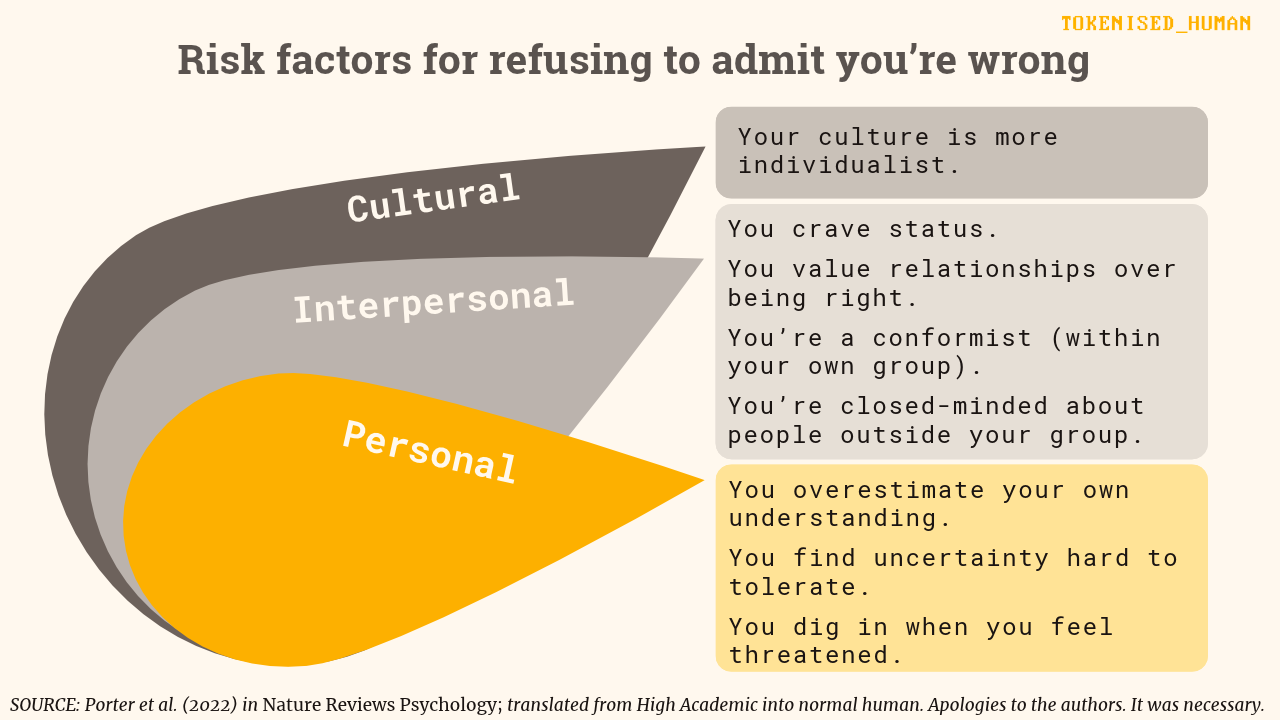
What little there is to try and tease out whether greater self-doubt might help or hinder your work in conjunction with AI, I would argue, pushes in favour of my overarching hypothesis here.
A 2023 study asked people to answer logic questions, then estimate how many they’d got right. Afterwards, they were given AI suggestions, some of which were wrong, and were allowed to change their answers. Those who underestimated their performance made more accurate decisions about whether to switch to the AI’s suggested answer than those who overestimated it.
Is that a perfect proxy? No.
Do you want me to do better research about this? OK, twist my arm (and help me find a sponsor for season two of the podcast!!).
And look, am I saying that unbridled imposter syndrome is good for your mental health and overall wellbeing? Hell no! It’s associated with increased worry, strain and in some cases procrastination of tasks that scare you. Might be good for your employer, overall, but not fab for you personally.
What I am saying is that perhaps we should always have characterised of imposter syndrome as the seed of a potential super-power, rather than something to beat out of yourself.
Maybe we could re-cast that instinct for self-doubt as the foundation of a healthy willingness to be proven wrong and change your mind? And in the end, isn’t that the stuff critical thinking and good judgement are made of?
If this letter gave you something to think about, consider forwarding it to one person who’d enjoy it too! Word of mouth is how a newsletter this new finds its people.
And I’d love to hear from you — reply to this email, comment in the app, or find me on LinkedIn.
Imposter? Impostor? The original researchers really couldn’t make up their minds on that one. Apparently, neither can I.
So much to say. I love the reframing. I also think I’ve always believed that a generous pinch of imposter syndrome is a good thing because it makes me do better, work harder and interrogate further. And I agree that men suffer probably as much as women but have been programmed not to talk about it for all sorts of reasons depending on how they grew up and who shaped that growing up. But I guess it depends on which side of the median you fall. I chased way too many rabbits down way too many holes and found it completely exhausting (debilitating even) especially when the stakes were high (or I perceived them to be high). I also believe, without any scholarly research but plenty of observations and anecdotal evidence collected over a lifetime, that imposter syndrome can also be an imprint of trauma. Especially childhood trauma. Just like perfectionism and hyper vigilance (but maybe that’s something for another day). Finally, linking it back to AI, it’s absolutely the case that questioning some of the slop it serves up is a very good thing. Shrieks of “well that’s f****ing nonsense!” can be heard from me, on the daily, when I look at Claude’s latest hot take on something. And if that’s the work of imposter syndrome, then I’ll take that thank you very much!