


I want to do something extra weird this week. I’m going to break the fourth wall even more directly than I usually do.
And I’m going to talk about something extremely personal (possibly embarrassingly?) but I suspect extremely common if not very discussed … and only AI-related in the most abstract and tangential sense if you really, really squint.
I want to talk to you about the profound grief of leaving a work community you loved.
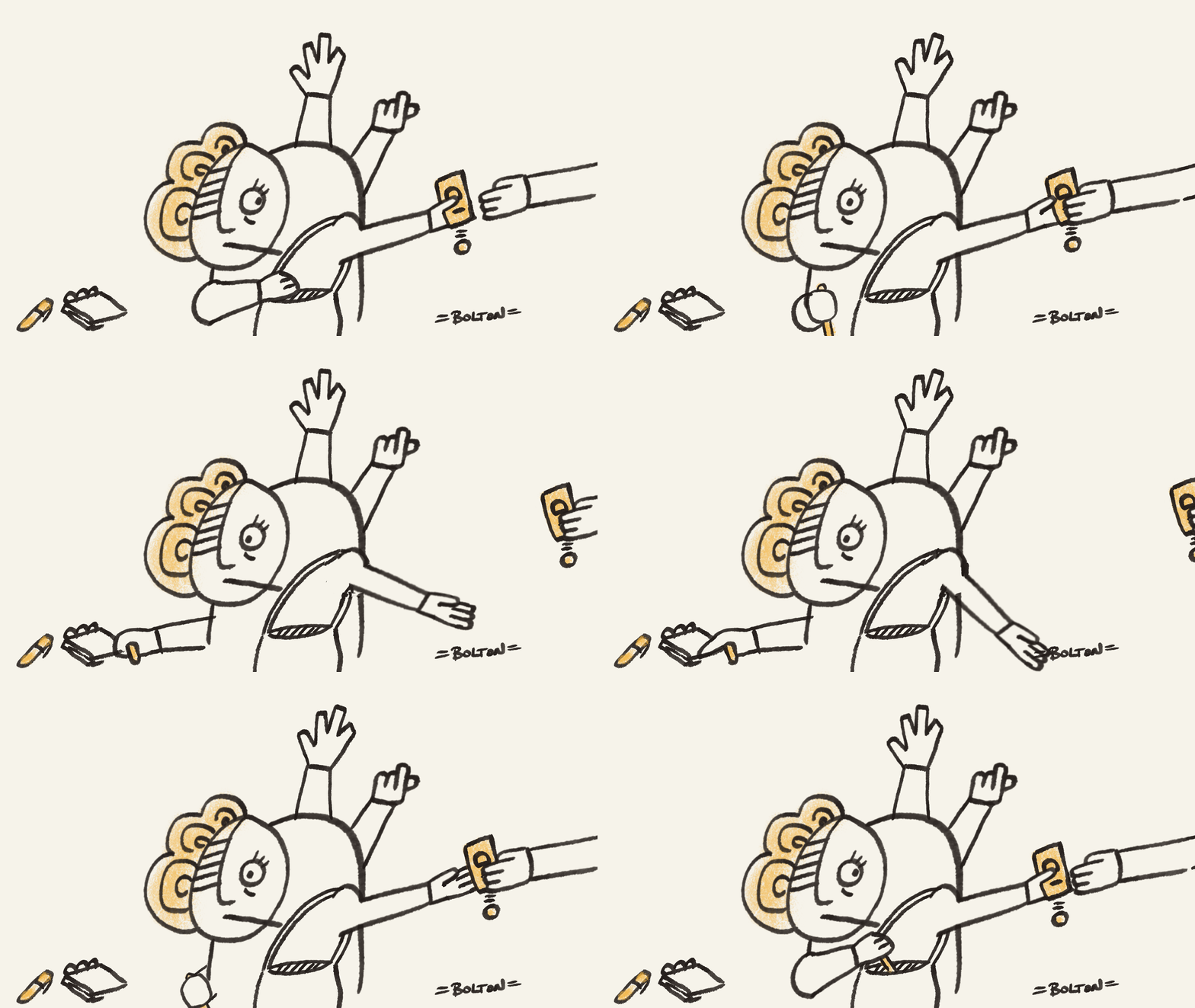
The (social) benefits package
As you may know, I left my staff role at The Australian Financial Review in July. It is a paper that I have considered a bit of a spiritual home since I did my traineeship there way back in 2009. And it is a place absolutely packed to the gills with funny, smart weirdos who I have been privileged to call colleagues and friends.
But the kinds of friendships that you build in a workplace can be very much interwoven with, and dependent on, the routines — day in and day out, year in and year out — of showing up and working side by side and laughing and helping and sharing so much time together.
And while individual relationships can endure after a work transition, the sense of belonging to the group as a whole is dispersed in the blink of an eye.
I was removed from the group WhatsApp a couple of weeks ago. And while I totally get why — oof it was painful.
You see, I grew up as an expatriate in Singapore in the ‘90s. And an expat life is essentially the transience of a workplace community applied to entire families, en masse.
As such, I have never much belonged to a large group of people to whom I felt permanently important. Don’t get me wrong, I have many individual friendships that I value highly. I’ve just never really had that sense that “the group needs me”.
But I really felt a sense of belonging at The Fin. When it comes to work, I think a lot of us do.
Profession. Payslip. Village.
In a time when religious service attendance and neighbourhood community are largely eroded, and even extended families tend to live apart, the workplace has for many of us become the true locus of community and belonging.
But unlike those other bonds, a work family is always inherently temporary and unstable. And when you leave, you are … just gone.
The research on what happens to work friendships post-departure is not, shall we say, over-abundant.
But a study published in 2018 reported on the former employees of Digital Equipment Corporation after the company itself disbanded. It essentially asked whether relationships built at work could survive once the shared social context was gone.
It found among nearly 1,700 former colleagues, after a decade, about 27 per cent retained no relationships at all. The average number of personal friendships that survived — defined as “in contact” at least once a year — was under four per person.
Of course, regular temporal proximity just makes creating and maintaining relationships easier.
When you’re not showing up to the same place each day to work together towards a shared goal, maintaining your connections requires effort.
And that effort is … effortful.
Research suggests you need to invest about 40-60 hours to transition from “acquaintance” to “casual friend”, 80-100 to get from casual to plain old “friend” and more than 200 hours to be considered “good friends”.
And you need to be in contact with someone about once a week for them to stay in your inner circle, once a month to keep them in your closest 15 relationships and once a year to maintain a connection in your larger group — usually up to 150 people.
More flexible careers, more fragile communities
The thing I’m hung up on is the fact that this is the main source of community for a lot of us today. And unlike times gone by, we’re also much more likely to switch jobs very regularly. The average time Australians spend in one job is around 3 years and 4 months. Which means we’re constantly dropping and starting new communities.
And I don’t know about you, but that makes me seriously sad.
Can you maintain individual connections after you leave? Absolutely. Can you build new community somewhere else? Sure. But I do think the structures around community used to be more durable — extended family, church, neighbours, old school friends, even long careers at the same organisation. I’m not suggesting that was some perfect social ideal. I just think belonging itself was less transient.
Regularly swapping jobs is now the norm. At the same time, more kinds of work are becoming casualised, and the “portfolio career” — or as I have been known to call it, “gig work in a suit” — is having a bit of a moment. These all bring more flexibility and choice, which can be great.
But I think we’ve lose something too. And I increasingly worry that something might have been even more important.
If this letter gave you something to think about, consider forwarding it to one person who’d enjoy it too! Word of mouth is how a newsletter this new finds its people.
And I’d love to hear from you — reply to this email, comment in the app, or find me on LinkedIn.
This is so true. Work is the only institution left it seems. I can’t help wondering if that is somehow the whole point of neoliberalism but I am probably being paranoid. The conspiracy theorist in me thinks that employers should be really happy with this outcome because if work is the only institutional connection we have it makes it very valuable to us.
Bloody hell, I thought I’d been booted from somewhere.
Your title worked.
It’s hard maintaining relationships with ex-colleagues. I left a firm 18 months ago. Terrible, toxic “wellness” firm, but the closeness we built as colleagues to numb the circus around us felt unbreakable.
We’ve all since moved on to pastures new. I’ve tried keeping in touch. Occasionally organising some drinks, but people naturally fall away. They have their lives, work, family, and a heap of things going on.
It’s sad. I miss them. This big, floating ball we’re on still spins away.