


For weeks people have been asking me whether I’m planning to buy into the Anthropic IPO.
I mean, it’s a fair question. I cover tech religiously, I use Claude (et al) on the daily, I do manage an SMSF and otherwise dabble in the stock market.
But the answer is a definite no. And I’ll tell you why.
(Before I do, I think it’s pretty obvious but this is not financial advice. I am not a financial adviser. This is just my opinion about the whole stack of cards. Do with it what you will.)
1. I’m fussy about the ethics
What counts as an ethically problematic investment is a super personal thing that every investor has to reflect on and reconcile in their own mind. Some of the boundaries I draw might be things you have no problem with.
In my case, my husband and I have a particular ethical matrix that we take into consideration when it comes to what we invest in – and an energy sucking tech whose own bosses believe might destroy the world is just not really measuring up. I’d rather miss out on unethical quick bucks than make some quick cash on something I don’t believe is ethically net neutral.
2. I prefer to hold stable, reliable things for a long time
Research suggests women tend to be, on the whole, a bit more conservative when it comes to their share portfolios, and that is true of me.
A 2023 paper by the Australian Securities Exchange, for example, found 55 per cent of female investors preferred stable reliable returns over moderate or high risk options, compared with 40 per cent of male investors who said the same.
Studies also indicate that women tend to trade in a way that is less hype-based and more measured – and that strategy tends to lead to better portfolio performance in general.
I am exceptionally tolerant of certain types of risk, but gambling brings me absolutely no joy.
3. I don’t personally think Anthropic is a good long-term bet
I don’t think any of the big model makers are, really.
To be clear, I am not here suggesting that AI giants will fail. It’s entirely plausible that people’s sheer religious faith in the value of LLM giants could prop them up for a good long while. This is an insane market, where material real world value can be decoupled from share performance – consider the antics of meme-stockery.
I am saying I don’t think the value in these monster models is as sky-high as people have convinced themselves it is.
I think we probably needed your OpenAIs and Anthropics to build their enormous, bloated, everything burrito models to learn how to make a model at all. But they are flabby, undisciplined and badly behaved because, ultimately, they were trained on a diet of – whatever the black hole could inhale. Good writing and bad writing; true information and lies; sense and nonsense.
Organisations report they are still failing to extract real financial value from their AI investments, even while motioning vaguely at alleged productivity gains. What I see is a bunch of people trying to herd a thousand AI cats – giant, unwieldy LLMs not built for purpose – when what they really want is a train driving reliably, efficiently and on schedule from point A to point B.
In McKinsey’s global survey conducted in May and June this year, 80 per cent of respondents claimed AI had made them personally more productive, but only 37 per cent said it had any effect on their company’s earnings. The share of companies getting “significant” value has stayed flat at about 6 per cent for two years.
PwC’s survey of chief executives found 56 per cent had seen neither higher revenue nor lower costs from AI in the previous 12 months.
Stanford’s recently published AI100 report concluded that AI “is not yet paying its way” in national economic data or company returns.
In a study published last week by project management software company monday.com, 62 per cent of Australian managers say the effort of working out where AI is worth using currently outweighs the effort AI saves them; 33 per cent say they have been working longer days since AI was introduced.
Gavin Watson is monday.com’s regional director for AI and growth and he says he’s seeing a lot of CFOs start to pump the brakes on their AI investments.
“I honestly think, over the next year, we’re actually going to see more of that,” he tells me. “I mean, you look at some of the examples out in the press where people’s token consumption went through the roof, and they actually had to turn it off. So I do feel like that’s going to start happening. I am hearing it.
“I even heard one one executive in a company say, ‘Can we just get back to how we were doing it before? Like we are spending all this money. I’m actually not clear that we’re getting any clear benefit in terms of uplifted to our revenue.’ So obviously they’re looking at the revenue.”
The explanations for why companies aren’t seeing that lift usually focus on “bottlenecks”.
Enjoying this? I think you’d also like:
This piece on how to audit your AI assistant to see if it’s actually doing a good job.
Or this one about why companies keep pouring money into AI even when it isn’t working.
Or maybe this one about why overwork makes us use AI badly.
Automation speeds up output at one point in a process, and the extra work piles up at the next. For example, that monday.com study found 47 per cent of managers have been spending more time reviewing and guiding their team’s output since AI became widespread. In Australia the figure was actually 59 per cent – the highest of any country of the seven surveyed.
As Watson put it, “Giving one employee ten agents doesn’t make them ten times more productive if they inherit ten streams of work to supervise.”
But we also have plenty of data points suggesting the bottleneck explanation may not be the whole story.
The bottleneck explanation assumes the extra output is worth reviewing. And we know a lot of it isn’t.
Researchers at Stanford’s Social Media Lab and coaching company BetterUp coined the term “workslop” for AI-made work that looks right but isn’t up to par. In a 2025 survey they found 40 per cent of US desk workers believed they had received workslop in the past month. More than half admitted sending it themselves.
A Glean survey of 6,000 workers in the US, UK and Australia found 77 per cent had corrected or redone AI-assisted work in the past month.
Researchers frequently blame management and unclear AI mandates for workslop, but as Culture Amp co-founder Didier Elzinga told me on the Tokenised Human podcast, the trap of AI can be feeling like you’re productive, because you’re constantly pushing things through the system, while doing very little real deep thinking at all.
“Like the AI’s writing it and then they’re sending it through because it takes too long to read,” he says. “And the person on the other hand goes, fuck it, I’m not reading this, and just shoves it through their AI and tell it says, Tell me what you think.”
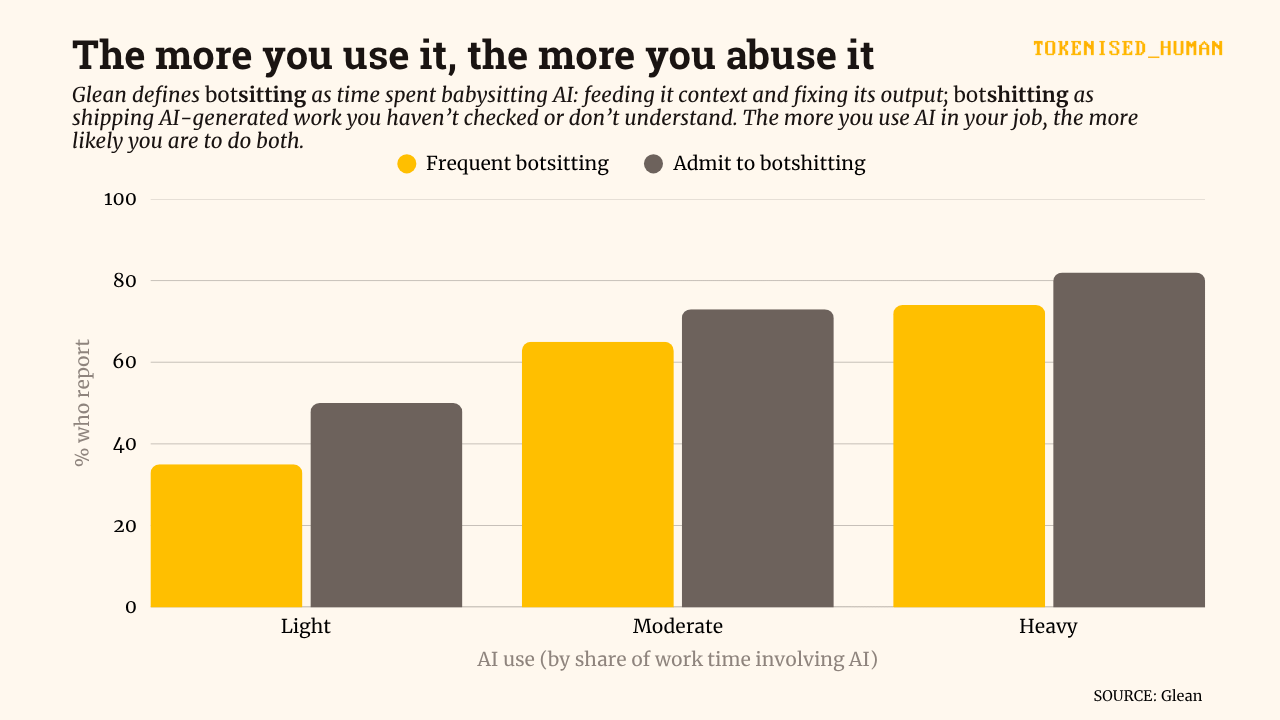
So even if we dislodged the blockages, why would we expect more of that getting through to produce greater real value?
Because the models undergirding so much of the workplace AI push are still mainly the same handful of gigantic overstuffed consumer models, this lack of upside feels, to me, inevitable. You’re relying on every employee to behave perfectly, notice when the tool is lying to them, and never click the magic button imprudently.
These models are bloated, built on a foundation of enormous volumes of unverified, unvetted internet information. And as a result they are just not very good.
The authors of the AI100 report predict the next phase of AI to be defined “less by repeated training of ever larger models and more by smarter algorithms and new ways of using potentially smaller models”. The report also points out that cheap “open-weight” models – AI models anyone can download and run privately, on their own computer, without paying for usage tokens – are now only three to six months behind the frontier models, and “many users find them to be good enough”.
I think the truly useful models of the future will be small, discrete, more energy efficient, purpose-built ones trained on very carefully selected data sets with a very narrow application, policed by experts who know what good looks like and keep them honest and on target. These models are already being built, and they will (I expect) be functional in a way that Claude or ChatGPT can never be.
You won’t have to worry about perfectly worded prompting or hallucination. I think the best AIs of 10 years from now will be plug-and-play. Idiot proof.
Once upon a time, if I wanted a fancy MySpace page I had to learn some HTML so I could do the fun colours and animate little boops. These days I could sign up for a website, click a few buttons, drag a few items around and have a fully functional e-retail store – accepting payments! – in about five minutes. I don’t need to understand how it works, it just does.
And that, I predict, is what a functional AI product will look like in 2036.
So, no. I will not be buying Anthropic. Other people are welcome to buy the sugar rush; I’ll wait for the meat and veg.
If this letter gave you something to think about, consider forwarding it to one person who’d enjoy it too! Word of mouth is how a newsletter this new finds its people.
And I’d love to hear from you — reply to this email, comment in the app, or find me on LinkedIn.
I have started to slowly lean more towards using AI, especially at work, yet I still remain skeptical and worry how much I'll give up to say this is progress. My gradual adoption feels good for me, I'm not all in yet.
I agree with your opinion about having smaller, personal models though, since that is what I thought should have happened in the beginning. Currently the companies have replicated the old mainframes of the distant past, meaning technology needs to now miniaturize to feel more useful (in my opinion). If models were developed that were still capable yet a lot smaller and less resource intensive so that it could fit on and be used by the one device we all have in our pockets - the mobile phone - then everyone would possess a useful AI assistant personal to them. How that would be monetized I have no idea - though I think that could also be said for the current trend of centralised LLMs.
I really liked hearing your opinions on this.
Interesting in your opinion on two things Rachael:
(1) of the major commercial AI companies, which one do you think is approaching the space most ethically? I think Claude is probably the least worst option of the bunch and in a capitalist world I’m not sure there will be a more ethical potential winner in the SI race (other than via Government intervention). Are you seeing something better out there?
(2) I agree that the commercial justification for investing are shaking at best. But I do think there’s a non-zero probability that one of these companies makes a major technological breakthrough that changes society as we know it. How do we value that?